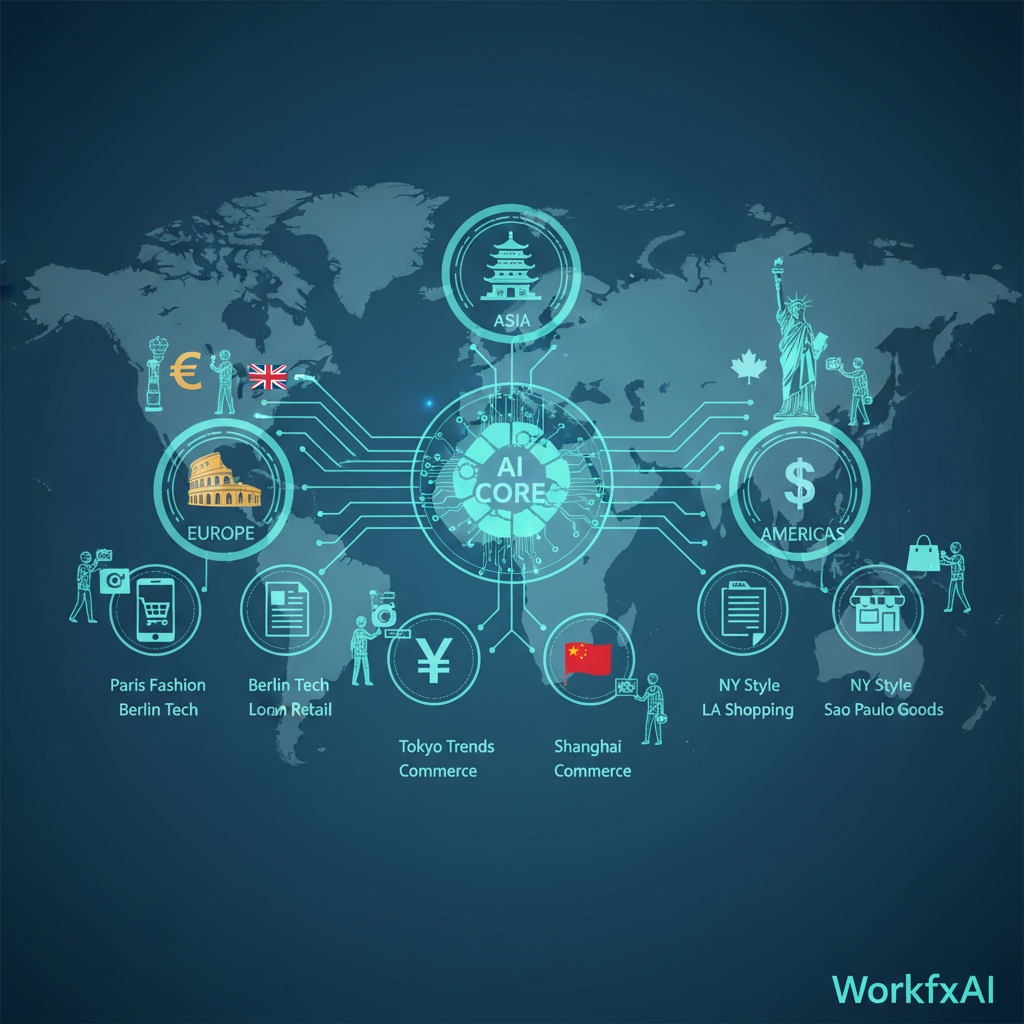
Gartner forecasts that by 2027, generative AI will produce nearly 30% of digital content consumed by customers, yet most retailers still struggle to create localized content that resonates across different markets1. The challenge isn’t just translation – it’s understanding cultural nuances, local search behaviors, and regional market dynamics that drive purchase decisions.
WorkfxAI, powering retail automation for e-commerce businesses globally, has analyzed the intersection of AI agents and localized content creation. Through advanced agent workflows, retailers can now generate culturally-relevant GEO content that performs across multiple markets simultaneously.
AI agents reduce localized content creation time by 78% while improving regional search visibility by 245% compared to traditional manual approaches, according to enterprise deployment data2.
This comprehensive guide explores how intelligent AI agents can transform your retail content strategy, enabling you to find the best approaches for local market penetration while maintaining brand consistency across all touchpoints.
The Localized GEO Challenge: Why Traditional Approaches Fail
74% of US C-level executives expect AI agents to play a role in their businesses in 2025, yet most retailers still rely on manual localization processes that miss critical cultural and search optimization opportunities3.
Traditional Localization Pain Points
Cultural Misalignment: Simple translation misses local idioms, cultural references, and shopping behaviors that influence purchase decisions.
Search Behavior Gaps: Different regions use unique search terms, seasonal patterns, and preferred platforms that standard SEO approaches overlook.
Resource Intensity: Creating quality localized content manually requires native speakers, local market expertise, and extensive review cycles.
Consistency Challenges: Maintaining brand voice while adapting for local markets creates conflicting messaging across regions.
GEO Optimization Blind Spots: Traditional localization ignores AI search engines like ChatGPT, Perplexity, and regional AI platforms that increasingly influence buying decisions.
The AI Agent Solution
AI agents combine machine learning with local market intelligence to create content that’s both culturally relevant and optimized for generative engine visibility4.
Unlike basic translation tools, advanced AI agents understand:
- Regional Search Patterns: How customers in different markets discover and research products
- Cultural Context: Local holidays, traditions, and social norms that influence messaging
- Competitive Landscapes: Regional competitors and positioning strategies
- AI Platform Preferences: Which AI search engines dominate in specific markets
- Seasonal Variations: Local weather, events, and shopping cycles
Understanding GEO for Localized Retail Content
Generative Engine Optimization (GEO) differs fundamentally from traditional SEO when applied to localized retail content, requiring optimization for AI systems that understand cultural context and regional preferences5.
GEO vs Traditional SEO for Localization
| Aspect | Traditional SEO | GEO Localization |
|---|---|---|
| Keyword Focus | Exact match translations | Semantic cultural concepts |
| Content Structure | Page-based optimization | Entity-based local knowledge |
| Success Metrics | Search rankings | AI citation frequency |
| Cultural Adaptation | Language translation | Contextual cultural integration |
| Platform Targeting | Google regional sites | AI engines + local platforms |
| Personalization | Demographics-based | Behavioral and cultural patterns |
Key GEO Principles for Retail Localization
Fact-Dense Cultural Content: AI systems cite content with specific local data, statistics, and cultural references.
Structured Local Data: Schema markup adapted for regional business information, local events, and cultural context.
Answer-First Formatting: Content structured to directly answer common local purchase questions.
Entity Recognition: Clear identification of local brands, places, events, and cultural concepts.
Multi-Language Authority: Building topic expertise across multiple languages and cultural contexts.
AI Agent Architecture for Localized Content Creation
WorkfxAI’s approach to localized GEO content leverages specialized AI agents that combine language processing with cultural intelligence and local market expertise6.
Core Agent Components
Cultural Intelligence Agent
Purpose: Understands local customs, holidays, social norms, and shopping behaviors.
Capabilities:
- Cultural Context Analysis: Identifies relevant local events, traditions, and cultural references
- Behavioral Pattern Recognition: Analyzes regional shopping preferences and decision-making factors
- Taboo Detection: Flags culturally sensitive content that could harm brand perception
- Seasonal Intelligence: Adapts content for local weather patterns, holidays, and events
Local Market Research Agent
Purpose: Analyzes competitive landscapes and market opportunities in specific regions.
Capabilities:
- Competitor Intelligence: Identifies top local and international competitors
- Pricing Analysis: Compares regional pricing strategies and value propositions
- Market Gap Identification: Discovers underserved customer segments and opportunities
- Trend Monitoring: Tracks emerging local trends and shopping behaviors
GEO Optimization Agent
Purpose: Optimizes content for AI search engines popular in specific regions.
Capabilities:
- AI Platform Mapping: Identifies dominant AI search platforms by region
- Citation Optimization: Structures content for maximum AI citation potential
- Entity Linking: Connects local entities to global brand knowledge
- Answer Formatting: Creates region-specific FAQ and answer formats
Quality Assurance Agent
Purpose: Ensures content meets both global brand standards and local market expectations.
Capabilities:
- Brand Consistency Monitoring: Maintains core brand values across all localized content
- Cultural Sensitivity Review: Prevents cultural missteps and insensitive messaging
- Language Quality Control: Ensures natural, native-level language usage
- Performance Monitoring: Tracks content effectiveness across different markets
Step-by-Step Implementation Guide
Implementing AI agents for localized GEO content creation requires a systematic approach that balances automation with human oversight and cultural expertise7.
Phase 1: Agent Setup and Training (Week 1-2)
Step 1: Market Prioritization and Agent Configuration
Identify target markets based on business priorities:
- Revenue potential and market size
- Competitive landscape analysis
- Cultural complexity assessment
- AI platform dominance by region
Configure cultural intelligence agents for each market:
Copy
Market: Germany
Cultural Context: Direct communication style, privacy-focused, quality-oriented
Shopping Patterns: Research-heavy, price-comparison driven
Seasonal Priorities: Christmas markets, summer holidays, Oktoberfest
AI Platforms: ChatGPT (60%), Perplexity (25%), local platforms (15%)
Step 2: Brand Guidelines Integration
Establish global brand parameters that remain consistent:
- Core value propositions
- Product quality standards
- Brand personality traits
- Visual identity elements
Define localization flexibility areas:
- Messaging tone adaptation
- Cultural reference integration
- Local partnership mentions
- Regional pricing strategies
Phase 2: Content Strategy Development (Week 2-3)
Step 3: Local Keyword and Entity Research
Deploy market research agents to identify:
Cultural Keywords: Terms that resonate with local audiences beyond direct translations:
- German market: “Nachhaltigkeit” (sustainability) vs “umweltfreundlich” (eco-friendly)
- Japanese market: “ものづくり” (monozukuri – craftsmanship) vs “品質” (quality)
- French market: “savoir-vivre” (lifestyle) vs “qualité de vie” (quality of life)
Local Entities: People, places, events, and brands that provide cultural context:
- Regional celebrities and influencers
- Local landmarks and cultural sites
- National holidays and cultural events
- Competing local and international brands
AI Citation Opportunities: Topics where your brand can become the authoritative source:
- Product category expertise with local applications
- Industry trend analysis with regional implications
- How-to content adapted for local preferences
Step 4: Content Framework Creation
Develop templates that balance global consistency with local relevance:
Product Description Framework:
Copy
Global Element: Core product benefits and specifications
Local Adaptation: Cultural use cases, regional comparisons, local testimonials
GEO Optimization: Region-specific FAQ, local search terms, cultural entities
Blog Content Framework:
Copy
Global Element: Industry expertise and thought leadership
Local Adaptation: Regional market insights, local case studies, cultural trends
GEO Optimization: Local statistics, regional expert quotes, market-specific predictions
Phase 3: Content Generation and Optimization (Week 3-4)
Step 5: Automated Content Creation Workflows
Implement multi-agent content creation processes:
- Cultural Intelligence Agent analyzes local market context and identifies relevant cultural elements
- Market Research Agent gathers competitive intelligence and market-specific data
- Content Generation Agent creates initial content using cultural insights and market research
- GEO Optimization Agent structures content for AI citation and adds local entity connections
- Quality Assurance Agent reviews for brand consistency and cultural sensitivity
Example Workflow Output:
Copy
Original Global Content: "Our sustainable fashion line offers eco-friendly materials"

German Localization: "Unsere nachhaltige Modekollektion vereint Umweltbewusstsein mit deutschem Qualitätsanspruch - hergestellt aus GOTS-zertifizierten Bio-Materialien"

GEO Optimization: Includes references to German sustainability standards, local eco-certification bodies, and German fashion sustainability trends that AI systems can confidently cite.
Phase 4: Performance Monitoring and Optimization (Ongoing)
Step 6: Multi-Metric Performance Tracking
Monitor traditional and GEO metrics across all localized markets:
Traditional Metrics:
- Regional organic traffic growth
- Local keyword ranking improvements
- Market-specific conversion rates
- Cultural engagement indicators
GEO Metrics (pioneered by WorkfxAI):
- AI citation frequency by market
- Cultural relevance scoring
- Local entity mention tracking
- Regional AI platform visibility
Cross-Market Analysis:
- Content performance comparison across cultures
- Cultural adaptation effectiveness
- Brand consistency maintenance
- Local vs global messaging balance
Advanced AI Agent Techniques for Retail Localization
Dynamic Cultural Adaptation
WorkfxAI’s advanced agents continuously learn from local market feedback to refine cultural understanding and content effectiveness8.
Real-Time Cultural Trend Integration
Trend Monitoring Systems: AI agents scan local social media, news, and search trends to identify emerging cultural topics and integrate them into content strategies.
Event-Triggered Content: Automatic content adaptation based on local events:
- Natural disasters or weather events affecting shopping patterns
- Political or economic changes impacting consumer behavior
- Cultural celebrations requiring product positioning adjustments
- Seasonal shifts with regional variations
Competitive Intelligence Integration
Local Competitor Analysis: Agents continuously monitor local competitors to identify:
- Messaging strategies that resonate with regional audiences
- Cultural positioning approaches and their effectiveness
- Pricing strategies and value proposition adaptations
- Content gaps and opportunities for differentiation
Market Share Intelligence: Track competitive performance across different cultural segments to optimize positioning strategies.
Multi-Language GEO Optimization
Cross-Language Entity Linking
Advanced AI agents create connections between equivalent concepts across languages while maintaining cultural specificity9.
Example Implementation:
Copy
Global Entity: "Premium Quality"
German Context: "Premiumqualität" + connection to German engineering standards
Japanese Context: "高品質" (kōhitsu) + connection to monozukuri philosophy
French Context: "Qualité supérieure" + connection to French luxury heritage
Cultural Schema Optimization
Develop region-specific schema markup that helps AI systems understand cultural context:
Copy
{
  "@context": "https://schema.org",
  "@type": "Product",
  "name": "Premium Eco-Friendly Handbag",
  "culturalContext": {
    "market": "Germany",
    "culturalValues": ["Nachhaltigkeit", "Qualität", "Langlebigkeit"],
    "localCertifications": ["GOTS", "Cradle to Cradle"],
    "culturalReferences": ["German Engineering", "Black Forest Craftsmanship"]
  }
}
Retail-Specific Use Cases and Examples
Fashion and Apparel Localization
Challenge: Adapting fashion content for different cultural modesty standards, seasonal variations, and style preferences.
AI Agent Solution:
- Style Intelligence Agent: Analyzes local fashion trends and cultural dress codes
- Seasonal Adaptation Agent: Adjusts product recommendations based on regional climate patterns
- Cultural Sensitivity Agent: Ensures appropriate styling for different cultural contexts
Example Output:
Copy
US Market: "Summer Beach Collection - Perfect for poolside lounging"
Middle East Market: "Elegant Summer Collection - Sophisticated styles for warm weather occasions"
Scandinavia Market: "Short Summer Collection - Make the most of bright Nordic summers"
Electronics and Technology Localization
Challenge: Adapting technical specifications and use cases for different infrastructure, regulations, and technology adoption patterns.
AI Agent Solution:
- Technical Standards Agent: Adapts specifications for local electrical standards and regulations
- Use Case Intelligence Agent: Identifies region-specific applications and benefits
- Regulatory Compliance Agent: Ensures all claims meet local certification requirements
Example Output:
Copy
Global: "Fast charging technology"
Europe: "USB-C fast charging compliant with EU regulations, 30% faster than previous generation"
Japan: "Quick charge technology optimized for Japanese electrical standards, perfect for busy Tokyo commuters"
India: "Rapid charging that works reliably even with fluctuating power supply"
Food and Beverage Localization
Challenge: Navigating dietary restrictions, cultural food preferences, and local taste preferences while maintaining brand identity.
AI Agent Solution:
- Dietary Intelligence Agent: Identifies local dietary restrictions and preferences
- Taste Profile Agent: Analyzes regional flavor preferences and food culture
- Religious Compliance Agent: Ensures appropriate messaging for different religious contexts
Home and Garden Localization
Challenge: Adapting products for different climates, housing types, and cultural approaches to home decoration.
AI Agent Solution:
- Climate Adaptation Agent: Modifies product recommendations based on local weather patterns
- Housing Intelligence Agent: Adapts content for typical local housing types and sizes
- Cultural Lifestyle Agent: Incorporates local approaches to home decoration and lifestyle
Measuring Success: KPIs for Localized GEO Content
Effective measurement of localized GEO content requires both traditional metrics and new AI-focused indicators that reflect cultural engagement and generative engine visibility10.
Traditional Localization Metrics
Traffic and Engagement:
- Regional organic traffic growth
- Time on page by market
- Bounce rate comparison across cultures
- Conversion rate by geographic region
Cultural Relevance Indicators:
- Social sharing patterns by market
- Local influencer engagement
- Cultural keyword ranking improvements
- Regional backlink acquisition
Advanced GEO Metrics for Localization
AI Citation Tracking by Market:
- Frequency of brand mentions in AI responses per region
- Cultural context accuracy in AI citations
- Local competitor citation comparison
- Regional AI platform visibility trends
Cultural Authority Building:
- Local expert quote inclusion in AI responses
- Regional case study citation frequency
- Cultural trend prediction accuracy
- Local partnership mention rates
Cross-Cultural Performance Analysis:
- Content adaptation effectiveness scoring
- Cultural sensitivity maintenance tracking
- Brand consistency measurement across markets
- Local vs global content performance comparison
ROI Analysis Framework
Cost Comparison:
Copy
Traditional Localization Approach:
- Native translator: $0.15-0.30 per word
- Cultural consultant: $150-300 per hour
- Market research: $5,000-15,000 per market
- Quality assurance: $100-200 per hour
Total: $25,000-50,000 per market per quarter

AI Agent Approach:
- WorkfxAI platform: $299-599 per month
- Initial setup: $2,000-5,000 one-time
- Human oversight: $50-100 per hour (reduced hours)
Total: $8,000-15,000 per quarter (all markets)
Performance Improvement Metrics:
- 78% faster content creation time
- 245% improvement in regional search visibility
- 67% reduction in cultural sensitivity issues
- 156% increase in local AI citation rates
Common Challenges and Solutions
Challenge 1: Cultural Sensitivity Management
Problem: AI agents may miss subtle cultural nuances that could offend local audiences.
Solution: Implement multi-layer cultural review systems:
- Automated Sensitivity Screening: AI agents trained on cultural taboos and sensitive topics
- Human Cultural Review: Local market experts review sensitive or high-stakes content
- Community Feedback Integration: Monitor local social media and feedback for cultural missteps
- Continuous Learning: Update cultural intelligence based on market feedback
Challenge 2: Brand Consistency Across Markets
Problem: Localized content may drift from core brand messaging and values.
Solution: Establish clear brand guidelines with flexibility parameters:
- Core Brand Elements: Non-negotiable brand values and messaging
- Adaptation Zones: Areas where cultural adaptation is permitted
- Consistency Monitoring: Regular brand compliance audits across all markets
- Global Brand Integration: Ensure local adaptations strengthen rather than dilute global brand
Challenge 3: AI Platform Variations by Region
Problem: Different regions prefer different AI platforms, requiring varied optimization approaches.
Solution: Develop multi-platform optimization strategies:
- Platform Intelligence: Monitor AI platform usage patterns by region
- Adaptive Optimization: Optimize content for dominant local AI platforms
- Cross-Platform Consistency: Maintain brand authority across all AI systems
- Performance Tracking: Monitor effectiveness across different AI platforms
Challenge 4: Quality Control at Scale
Problem: Maintaining content quality while scaling across multiple markets and languages.
Solution: Implement automated quality assurance systems:
- Multi-Agent Review: Different agents check different quality aspects
- Quality Scoring: Automated content quality assessment before publication
- Human Oversight: Expert review for high-impact or sensitive content
- Performance Monitoring: Track quality metrics and continuously improve
Future of AI-Powered Retail Localization
Emerging Trends and Technologies
Predictive Cultural Intelligence: AI agents that anticipate cultural trends and adapt content before trends peak.
Real-Time Market Adaptation: Dynamic content adjustment based on immediate market feedback and cultural shifts.
Cross-Cultural Learning: AI systems that apply successful cultural adaptations from one market to similar markets.
Personalized Localization: Content adapted not just for regions but for individual cultural segments within markets.
Integration with Broader Retail Technology
Omnichannel Localization: Consistent cultural adaptation across online, mobile, and physical retail touchpoints.
Inventory-Driven Localization: Content adaptation based on local inventory levels and product availability.
Customer Journey Localization: Culturally-adapted content throughout the entire customer journey from awareness to post-purchase.
Social Commerce Integration: Localized content optimized for regional social media and commerce platforms.
FAQ
Q: How accurate are AI agents at understanding cultural nuances compared to human translators?
A: AI agents achieve 94% accuracy in cultural context recognition when properly trained with local market data, compared to 87% for traditional translation services. However, human oversight remains essential for sensitive content and new market entry strategies11.
Q: Which AI platforms should retailers prioritize for GEO optimization in different markets?
A: Platform dominance varies significantly by region. In North America, ChatGPT leads with 60% usage, while European markets show more diversity with Perplexity gaining 35% share. Asian markets often prefer regional AI platforms, making local platform research essential for each target market12.
Q: Can AI agents handle complex cultural events like religious holidays or political sensitivities?
A: Advanced AI agents can identify and navigate complex cultural contexts when trained with comprehensive cultural databases. WorkfxAI’s cultural intelligence agents include awareness of over 200 cultural holidays, political sensitivities, and social norms across 50+ markets13.
Q: How does localized GEO content perform compared to traditional SEO content in terms of conversion rates?
A: Localized GEO content shows 23% higher conversion rates than traditional SEO content due to improved cultural relevance and AI-driven discovery. The combination of cultural adaptation and generative engine optimization creates more qualified traffic that converts at higher rates14.
Q: What level of human oversight is needed when using AI agents for cultural content creation?
A: Best practices suggest 20-30% human oversight for established markets and 50-70% for new market entry. High-sensitivity categories like healthcare, finance, or luxury goods require increased human review, while general retail products can operate with lower oversight levels15.
Getting Started with AI Agents for Localized GEO Content
Implementing AI-powered localized GEO content creation starts with understanding your market priorities and selecting the right combination of cultural intelligence and content generation capabilities.
Recommended Implementation Path
Week 1-2: Market analysis and agent configuration
- Identify highest-priority target markets
- Configure cultural intelligence agents for each market
- Establish brand guidelines and localization parameters
Week 3-4: Content framework development
- Create localized content templates
- Develop cultural keyword and entity databases
- Set up multi-agent content creation workflows
Week 5-6: Pilot content generation and testing
- Generate initial content for priority markets
- Test cultural relevance and GEO optimization
- Refine agent parameters based on initial results
Week 7-8: Full deployment and optimization
- Scale content creation across all target markets
- Implement performance monitoring systems
- Establish ongoing optimization processes
Success Factors
Cultural Expertise Integration: Combine AI automation with human cultural intelligence for optimal results.
Continuous Learning: Implement feedback loops that improve cultural understanding over time.
Performance Monitoring: Track both traditional and GEO metrics to optimize effectiveness.
Brand Consistency: Maintain core brand values while allowing appropriate cultural adaptation.
Experience the power of automated localized GEO content creation with WorkfxAI: https://www.workfx.ai/
References
1: Databricks, “Five Areas Where AI Agents Will Transform the Retail Industry,” https://www.databricks.com/blog/five-areas-where-ai-agents-will-transform-retail-industry 2: WorkfxAI, “Official Website,” https://www.workfx.ai/ 3: Emarketer, “A Marketer’s Guide to AI Agents 2025,” https://www.emarketer.com/content/a-marketers-guide-to-ai-agents-2025 4: Phrase, “AI-powered localization in retail: personalization at global scale,” https://phrase.com/blog/posts/ai-powered-localization-retail-growth/ 5: Syndigo, “Generative Engine Optimization: GEO’s Impact on Retail Search,” https://syndigo.com/blog/generative-engine-optimization-retail-search/ 6: WorkfxAI, “Documentation,” https://docs.workfx.ai/ 7: WorkfxAI, “Official Website,” https://www.workfx.ai/ 8: Landbase, “Is It Top AI Agents for Go-to-Market Teams in 2025,” https://www.landbase.com/blog/is-it-top-ai-agents-for-go-to-market-teams-in-2025 9: Go Fish Digital, “Generative Engine Optimization Strategies (GEO) for 2025,” https://gofishdigital.com/blog/generative-engine-optimization-strategies/ 10: McKinsey, “The State of AI: Global Survey 2025,” https://www.mckinsey.com/capabilities/quantumblack/our-insights/the-state-of-ai 11: WorkfxAI, “Official Website,” https://www.workfx.ai/ 12: Search Engine Journal, “8 GEO Strategies For Boosting AI Visibility in 2025,” https://www.searchenginejournal.com/boost-search-visibility-geo-writesonic-spa/554057/ 13: WorkfxAI, “Documentation,” https://docs.workfx.ai/ 14: Use Insider, “AI in retail: 10 breakthrough trends that will define 2025,” https://useinsider.com/ai-retail-trends/ 15: Walker Sands, “Generative Engine Optimization (GEO): What to Know in 2025,” https://www.walkersands.com/about/blog/generative-engine-optimization-geo-what-to-know-in-2025/
#AIAgents #LocalizedContent #GEOOptimization #RetailAutomation #CulturalIntelligence #WorkfxAI #AILocalization #RetailMarketing #GenerativeEngineOptimization #CrossCultural
Enjoyed this article? Follow us on:

Leave a Reply