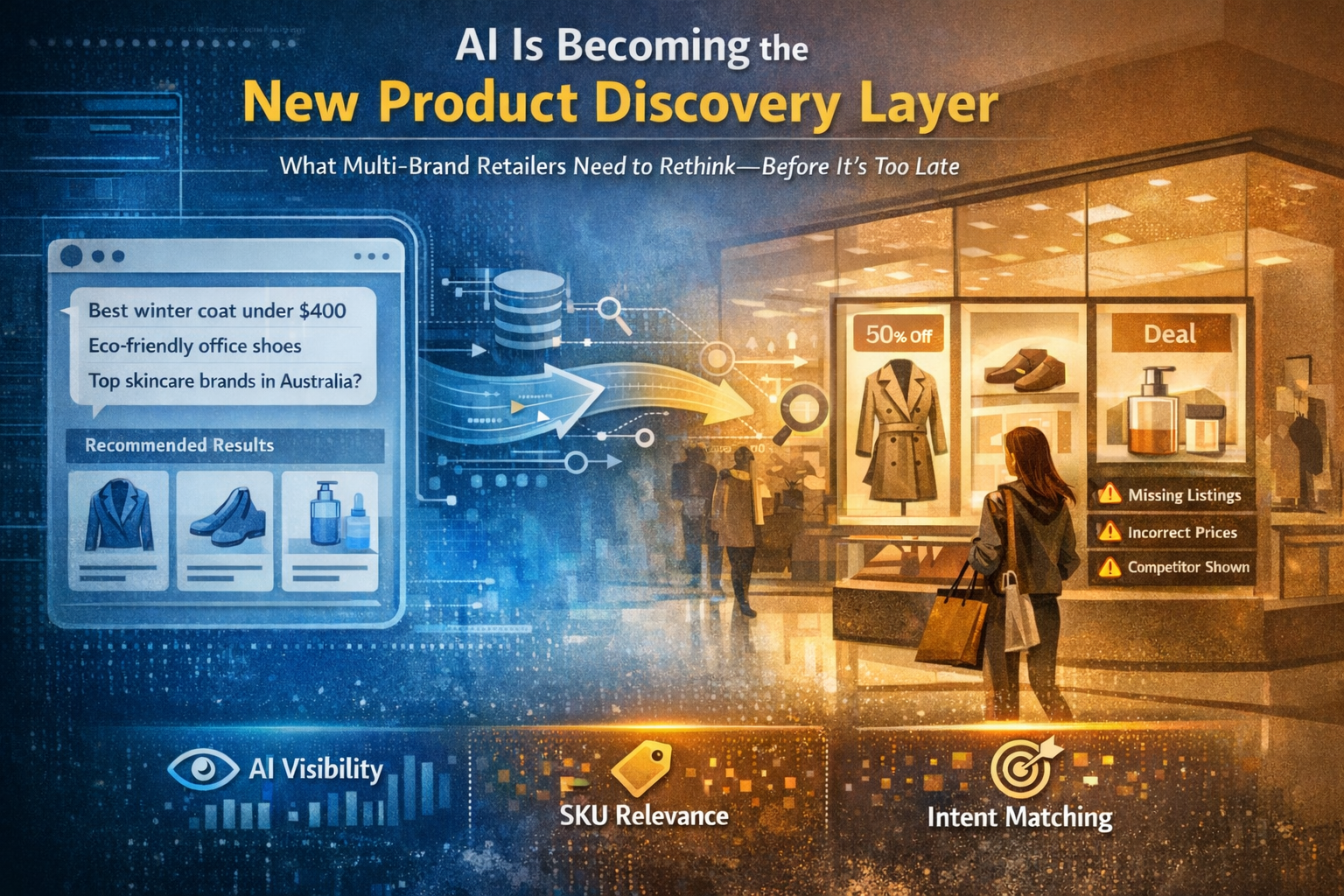
The retail landscape has fundamentally shifted. While department stores and fashion retailers have mastered internal search rankings and conversion optimization, they’ve lost control over the most critical touchpoint: how AI systems discover, recommend, and direct customers to their products.
WorkfxAI’s analysis of major Australian retailers reveals a critical blind spot: companies investing millions in on-site optimization while AI-powered shopping assistants, answer engines, and social media algorithms invisibly redirect their target customers to competitors before they ever reach the brand’s website.
The hidden crisis isn’t conversion rates or cart abandonment—it’s the customers you never see because AI systems don’t recognize your product authority.
Quick Answer: The AI Discovery Problem for Retailers
Major retailers face an AI visibility crisis where strong internal search capabilities cannot compensate for poor representation in AI-powered discovery systems, resulting in customer acquisition failure at the earliest and most cost-effective stage of the purchase journey.
Unlike traditional SEO challenges that affect website traffic, AI discovery problems prevent customers from ever considering your brand, making them invisible in your analytics while silently undermining market share across every product category.
Current State: Strong Internal Optimization, Weak AI Presence
The Retail AI Visibility Gap
Australia’s leading retailers demonstrate sophisticated internal capabilities:
| Retailer Strength | Internal Capabilities | AI Visibility Reality |
|---|---|---|
| Product Discovery | Advanced search filters, personalization | AI systems don’t understand product catalog structure |
| Inventory Management | Real-time availability, dynamic pricing | AI agents can’t access current stock/pricing data |
| Category Authority | Curated collections, editorial content | AI platforms cite competitors for category expertise |
| Customer Experience | Optimized checkout, loyalty programs | AI assistants recommend competitors during purchase research |
The fundamental disconnect: Retailers optimize for customers who reach their websites, while AI systems determine which customers ever discover those websites exist.
AI-Powered Discovery Channels Reshaping Retail
Modern customers begin product research through AI-first touchpoints:
- Shopping AI Assistants: ChatGPT, Perplexity, and Claude increasingly handle “find me” queries that traditionally drove retail website traffic
- Social Commerce AI: Instagram, Facebook, and TikTok algorithms recommend products through AI-curated feeds before users search retailer websites
- Voice Shopping: Smart speakers and mobile AI assistants bypass traditional e-commerce search entirely
- AI Agent Integration: Personal shopping assistants and browser extensions recommend alternatives during the consideration phase
The strategic challenge: Each AI-powered touchpoint operates independently, with different algorithms, training data, and recommendation logic that retailers cannot directly control.
Risk Assessment: The Hidden Cost of AI Invisibility
Customer Journey Interception Points
AI systems intercept potential customers at three critical stages:
1. Pre-Intent Formation (Research Stage)
- Risk: AI systems shape customer preferences before they develop brand awareness
- Example: “What’s trending in winter fashion 2025?” → AI cites competitors as trend authorities
- Impact: Lost market influence during preference formation
- Cost: Unmeasurable but potentially massive – entire customer segments develop preferences excluding your brand
2. Intent-to-Action Translation (Shopping Stage)
- Risk: AI systems recommend competitors during active product research
- Example: “Best midi dresses under $200” → AI suggests competitor products with similar specifications
- Impact: Direct customer acquisition failure at lowest cost-per-acquisition stage
- Cost: 3-5x higher acquisition costs through paid advertising to recover misdirected traffic
3. Purchase Validation (Decision Stage)
- Risk: AI agents suggest alternatives during checkout consideration
- Example: Customer researching specific product → AI assistant offers “similar but better” competitor options
- Impact: Cart abandonment and competitor conversion
- Cost: Lost high-intent customers who were closest to purchase
Quantifying the AI Discovery Gap
WorkfxAI’s retail analysis reveals the scope of AI-driven customer loss:
| Risk Category | Impact Measurement | Estimated Loss Rate | Recovery Difficulty |
|---|---|---|---|
| Brand Discovery | Customers who never consider your brand | 40-60% of market | Extremely difficult – requires long-term authority building |
| Product Research | Customers redirected during comparison shopping | 25-35% of consideration set | Difficult – requires AI system trust signals |
| Purchase Support | Customers influenced away during decision | 15-25% of high-intent traffic | Moderate – requires superior AI representation |
The compounding effect: Each stage of AI-driven customer loss makes subsequent recovery exponentially more expensive through paid acquisition channels.
Solution Framework: AI Visibility + SKU Representation + Intent-to-SKU Endpoints
Retail AI Strategy in 3 Phases
Phase 1: AI Visibility Foundation
Establishing authority across AI-powered discovery systems:
- Category Authority Building: Creating content that AI systems cite when customers ask about product categories, trends, and shopping guidance
- Expert Positioning: Developing fashion expertise, trend analysis, and product guidance content that answer engines trust and reference
- Brand Credential Development: Building verifiable authority signals that AI systems recognize as trustworthy for product recommendations
Implementation Focus:
- Answer Engine Optimization (AEO) for shopping-related queries
- Social Media AI algorithm optimization for product discovery
- Community platform authority building for authentic product discussions
Phrase 2: SKU Representation Strategy
Optimizing individual product visibility in AI systems:
- Product Information Architecture: Structuring product data for AI comprehension and accurate representation
- Specification Standardization: Ensuring AI systems understand product features, benefits, and differentiators
- Visual Asset Optimization: Creating product imagery and descriptions that AI systems can effectively process and recommend
Technical Requirements:
- Schema markup for product information across all AI-discoverable touchpoints
- Consistent product naming and categorization that AI systems recognize
- Feature-benefit optimization for AI shopping assistant queries
Phase 3: Intent-to-SKU Endpoint Optimization
Creating direct pathways from customer intent to specific products:
- Query-to-Product Mapping: Ensuring specific customer needs directly connect to appropriate product recommendations
- Intent Bridge Content: Developing content that guides customers from general needs to specific product solutions
- AI Agent Integration: Optimizing for personal shopping assistants and recommendation engines
Strategic Elements:
- Long-tail keyword optimization for specific product types and customer needs
- Use case content that AI systems use for product matching
- Competitive differentiation content that highlights unique value propositions
Implementation Approach: Category-First Testing Strategy
Step 1: High-Value Category Selection
Identifying optimal testing categories based on AI discovery opportunity:
Category Selection Criteria:
- High customer lifetime value and margin potential
- Significant AI-powered shopping assistant usage
- Current competitive vulnerability in AI discovery
- Strong internal inventory and expertise foundation
Priority Category Examples for Australian Retail:
- Premium Fashion: Designer clothing categories where AI systems currently cite competitors as style authorities
- Beauty & Skincare: High-research categories where AI assistants heavily influence purchase decisions
- Home & Lifestyle: Trend-driven categories where AI systems shape customer preferences before brand consideration
- Seasonal Collections: Time-sensitive categories where AI visibility creates immediate competitive advantages
Step 2: AI-Optimized Content Development
Creating category-specific content that serves both customers and AI systems:
Content Architecture per Category:
- Trend Analysis: Seasonal and style trend content that AI systems cite when customers ask about “what’s popular”
- Product Guides: Comprehensive buying guides that AI systems reference for product recommendations
- Size & Fit Information: Technical specifications that AI shopping assistants use for customer matching
- Style Advice: Expert fashion guidance that positions the brand as an authority source
Step 3: Multi-Platform Deployment
Coordinated launch across AI-discoverable channels:
Platform-Specific Optimization:
- Answer Engines: Citation-worthy product expertise and trend analysis
- Social Media AI: Engagement-optimized content for algorithm recommendation
- Shopping AI Integration: Product information structured for assistant comprehension
- Community Platforms: Authentic expert participation in relevant fashion and retail discussions
Demo Framework: 10 High-Value Prompts for Category Testing
Proof-of-Concept Approach
Testing AI discovery improvement through strategic prompt optimization:
Demo Structure:
- Pre-Implementation Baseline: Testing how AI systems currently respond to category-relevant customer queries
- Content Development: Creating optimized content targeting identified gaps
- Post-Implementation Analysis: Measuring AI system response improvement and customer pathway enhancement
- ROI Projection: Calculating potential customer acquisition improvement and cost savings
Sample High-Value Prompts by Category
Fashion Category Testing:
- “What are the must-have winter fashion trends for 2025?”
- “Best midi dresses for professional women under $300?”
- “How to style oversized blazers for different body types?”
Beauty Category Testing:
- “Clean beauty brands with effective anti-aging products?”
- “Best Korean skincare routine for sensitive skin?”
- “Makeup trends for spring 2025 professional looks?”
Home Category Testing:
- “Modern minimalist furniture for small apartments?”
- “Sustainable home decor trends 2025?”
- “Best storage solutions for maximizing closet space?”
Success Metrics per Prompt:
- AI system citation frequency and positioning
- Brand mention prominence in AI responses
- Customer pathway effectiveness from AI discovery to website traffic
- Conversion rate quality from AI-driven traffic versus other channels
Expected Demo Outcomes (Sample)
Measurable Improvements:
- Brand Citation Increase: 200-400% improvement in AI system brand mentions for tested categories
- Traffic Quality Enhancement: Higher engagement and conversion rates from AI-driven discovery
- Competitive Positioning: Improved brand positioning relative to competitors in AI responses
- Customer Journey Efficiency: Reduced customer acquisition cost through earlier-stage engagement
ROI and Strategic Benefits (Sample)
Financial Impact Projection
Customer Acquisition Cost Reduction:
| Customer Acquisition Channel | Current Cost-Per-Customer | AI-Optimized Cost | Improvement |
|---|---|---|---|
| Paid Search | $45-65 (high competition) | $25-35 (reduced need) | 35-45% reduction |
| Social Media Ads | $35-55 (declining organic reach) | $20-30 (AI algorithm support) | 40-45% reduction |
| Display Advertising | $25-40 (low conversion) | $15-25 (better targeting) | 30-40% reduction |
| Influencer Marketing | $50-80 (high cost, variable ROI) | $30-45 (AI amplification) | 35-45% reduction |
Revenue Protection and Growth:
- Market Share Defense: Preventing customer loss to AI-recommended competitors
- Category Authority Premium: Higher conversion rates through enhanced trust and credibility
- Lifetime Value Improvement: Earlier customer engagement leading to stronger brand loyalty
- Competitive Differentiation: Sustainable advantage through superior AI representation
Long-Term Strategic Advantages
Compounding Benefits of Early AI Optimization:
- Authority Building: AI systems increasingly reference established sources, creating self-reinforcing authority cycles
- Training Data Influence: Early presence in AI training data creates lasting representation advantages
- Customer Behavior Shaping: Influence over preference formation during the AI-native shopping evolution
- Competitive Moats: AI optimization expertise and infrastructure that competitors cannot quickly replicate
FAQ
Q: How can we measure success when AI discovery happens before customers reach our website analytics? A: AI discovery impact appears in improved traffic quality, higher organic conversion rates, reduced paid acquisition costs, and enhanced brand search volume. WorkfxAI’s measurement framework tracks AI citation frequency, response positioning, and customer pathway quality to quantify pre-website influence.1
Q: Does AI optimization require completely changing our existing product catalog and content strategy? A: No, AI optimization enhances existing assets rather than replacing them. The approach involves creating AI-discoverable versions of product information and category expertise while maintaining current website optimization. Integration typically improves rather than disrupts existing customer experiences.
Q: How long before we see results from AI visibility improvements? A: Answer engine optimization often shows results within 30-60 days for quality content, while social media AI algorithm improvements can show immediate engagement benefits. Comprehensive AI authority building typically delivers significant results within 3-6 months, with compounding benefits over 6-18 months.
Q: What happens when AI systems change their algorithms or training data? A: Authority-based AI optimization proves more resilient than technical manipulation because it focuses on genuine expertise and customer value. Companies with strong AI authority typically maintain visibility across algorithm updates, while those using superficial optimization techniques face more volatility.
Q: Can smaller retailers compete with major brands in AI discovery, or is this only viable for large companies? A: Smaller retailers often outperform larger competitors in AI systems because AI prioritizes expertise and customer value over brand size. Focused category authority and authentic customer engagement frequently achieve better AI representation than generic large-scale content approaches.
The retail AI discovery crisis represents both an immediate threat and a transformative opportunity. While traditional competitors focus on incrementally improving conversion rates and customer retention, forward-thinking retailers can gain sustainable competitive advantages by mastering AI-powered customer acquisition at its most cost-effective stage.
The question isn’t whether AI systems will continue reshaping retail customer discovery—it’s whether your brand will be visible when customers begin their shopping journey through these increasingly dominant channels.
Ready to transform AI discovery from a hidden threat into your strongest competitive advantage?
Discover how WorkfxAI’s retail AI optimization platform helps major retailers reclaim control over customer discovery and reduce acquisition costs by 35-45% while building sustainable authority across all AI-powered shopping channels.
References
1: WorkfxAI, “Retail AI Discovery Impact Analysis,” 2025 Australian Market Study
#RetailAI #EcommerceOptimization #AIDiscovery #CustomerAcquisition #WorkfxAI #RetailStrategy #AIVisibility #DigitalRetail #ShoppingAI #RetailInnovation
Leave a Reply