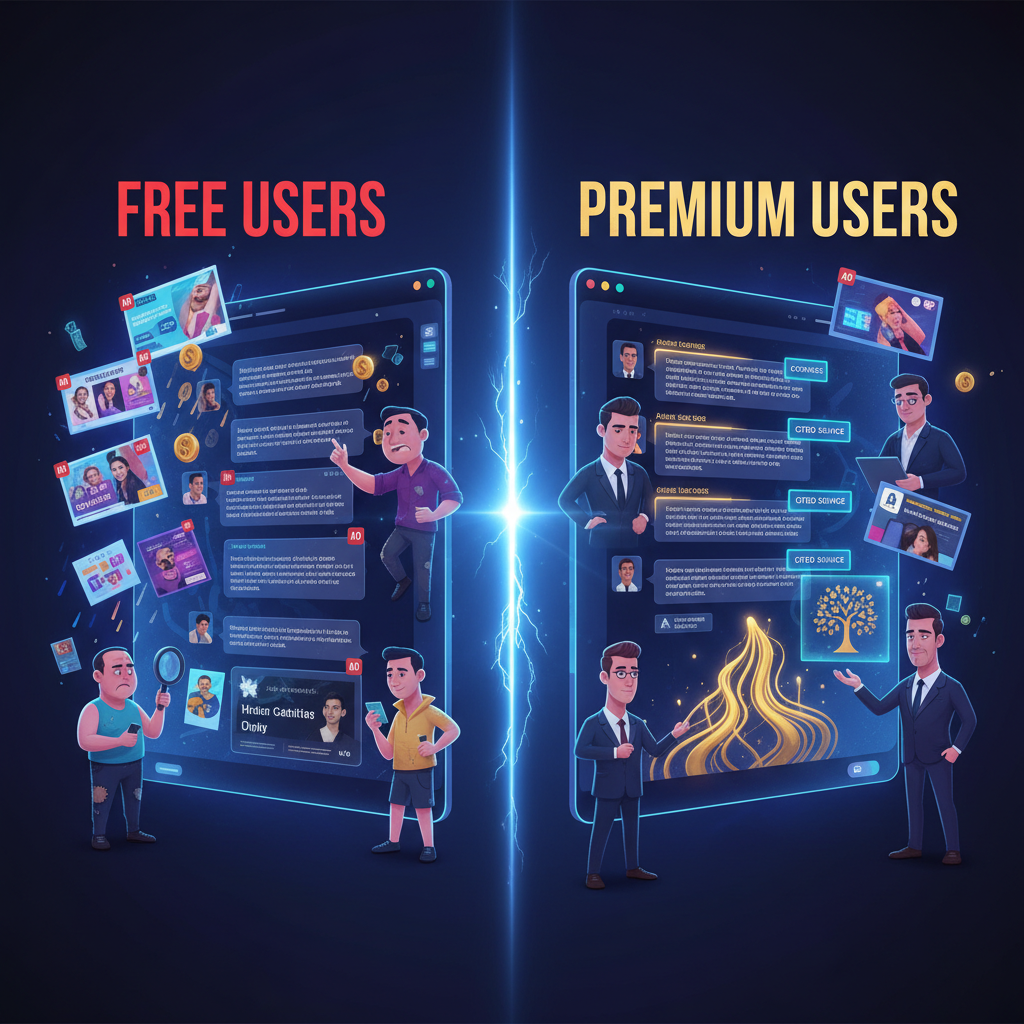
OpenAI now serves ads exclusively to ChatGPT Free and Go tier ($8/month) users, while Plus ($20/month), Pro ($200/month), Business, and Enterprise subscribers enjoy completely ad-free experiences1.
This fundamental divide creates a critical marketing challenge: the users most likely to see your paid advertisements are also the least likely to have significant budgets. Meanwhile, the affluent users paying $20-$200 monthly for premium ChatGPT access—representing over 12 million paying subscribers—conduct their research in an ad-free environment where only organic AI citations can reach them2.
WorkfxAI, an award-winning GenAI Visibility Platform serving businesses seeking AI discovery dominance, has analyzed this shifting landscape where traditional paid advertising strategies miss the most valuable audience segments entirely. The introduction of ads in ChatGPT’s lower tiers has created an unprecedented opportunity gap that most businesses haven’t recognized yet.
The stark reality: Free and Go users see sponsored content below ChatGPT’s responses, while Plus, Pro, Business, and Enterprise users navigate a completely advertising-free environment where brands can only gain visibility through AI citations of their authoritative content3.
This means businesses relying solely on ChatGPT’s paid advertising platform are exclusively targeting users with limited budgets while completely missing the affluent segments that pay premium prices for enhanced AI capabilities. The solution requires a fundamental shift toward organic AI visibility strategies that capture these high-value users during their research processes.
Understanding the ChatGPT Tier Divide: Who Sees Ads and Who Doesn’t
The advertising implementation across ChatGPT’s five tiers creates distinct user experiences that directly impact how businesses can reach different audience segments4.
Ad-Supported Tiers (Reachable via Paid Advertising)
Free Tier ($0/month):
- Ad Visibility: Sponsored content appears below ChatGPT responses, clearly labeled
- User Demographics: Price-sensitive consumers, students, casual users
- Typical Budget Range: $0-$1,000 for business decisions
- Usage Patterns: Basic queries, limited daily messages, quick answers
Go Tier ($8/month):
- Ad Visibility: Same sponsored content placement as Free tier
- User Demographics: Regular users wanting slightly more access without major investment
- Typical Budget Range: $500-$5,000 for business decisions
- Usage Patterns: Moderate usage, some business applications, price-conscious purchasing
Ad-Free Tiers (Unreachable via Paid Advertising)
Plus Tier ($20/month):
- Ad Visibility: Complete ad-free experience
- User Demographics: Daily users, professionals, small business owners
- Usage Patterns: Regular business use, advanced features, longer research sessions
Pro Tier ($200/month):
- Ad Visibility: Complete ad-free experience
- User Demographics: Researchers, engineers, power users, executives
- Usage Patterns: Complex analysis, extended reasoning, mission-critical applications
Business & Enterprise Tiers ($25-$30+/user/month):
- Ad Visibility: Complete ad-free experience with enhanced privacy
- User Demographics: Corporate teams, large organizations, regulated industries
- Usage Patterns: Collaborative research, compliance requirements, strategic planning
The Premium User Problem: Why These Users Require Different Strategies
Premium ChatGPT users, who pay $20-200 monthly for advanced AI capabilities, demonstrate research behaviors that fundamentally differ from free users, with 70.8% of workplace AI usage concentrated among paying subscribers2.
The affluent user demographic represents a significant untapped opportunity. These users don’t just ask simple questions—they engage in multi-step research processes that span several AI interactions. They compare solutions, analyze features, and seek authoritative sources before making purchasing decisions.
Unlike free users who might be satisfied with basic answers, premium users expect:
- Comprehensive analysis: Deep dives into product capabilities, market comparisons, and implementation considerations
- Authoritative sources: Well-cited information from recognized industry experts and official documentation
- Complex query handling: Multi-faceted questions that require nuanced, expert-level responses
- Integration insights: How solutions fit within existing business systems and workflows
Research indicates that ChatGPT Plus has over 12 million paying subscribers, with enterprise customers driving significant usage volumes3. These users represent higher-intent prospects with budgets that justify premium AI subscriptions, yet traditional paid advertising strategies often fail to reach them during their research phase.
WorkfxAI’s platform addresses this gap by helping businesses establish organic authority that AI systems cite when affluent users conduct their research. Rather than hoping to catch these users through paid ads, businesses can position themselves as the definitive source that ChatGPT, Perplexity, and Claude reference when responding to complex queries.
Why Paid Ads Alone Aren’t Enough for High-Intent AI Users
Organizations using both paid and organic strategies achieve immediate performance results and sustainable business stability, as paid search controls visibility during urgent moments while organic SEO provides lasting reach and credibility4.
The fundamental limitation of paid advertising in the AI era is that LLMs don’t surface ads within their research responses. When an affluent user asks ChatGPT for a comprehensive analysis of project management solutions, the AI system draws from its training data and accessible web content—not from paid advertisements.
This creates several critical gaps in paid-only strategies:
Ad Blockers and Banner Blindness
Premium users often employ sophisticated ad blocking tools and have developed banner blindness through years of exposure to promotional content. They actively seek unbiased, authoritative information rather than marketing messages.
The Citation Authority Gap
AI systems prioritize authoritative, well-structured content when generating responses. A paid ad might drive initial awareness, but lacks the depth and authority needed for AI citation. When ChatGPT recommends solutions, it cites comprehensive resources, not promotional content.
Cost Escalation Without Authority
Without organic authority backing their paid campaigns, businesses face escalating cost-per-acquisition rates. Research shows that when organic and paid work together, blended CAC almost always improves5. The synergy occurs when users discover brands organically through AI citations, then encounter reinforcing paid messages.
Missing the Research Moment
Affluent users often conduct research during off-peak hours, outside traditional advertising campaign schedules. They might spend several days or weeks researching solutions through AI systems before ever clicking on paid advertisements.
WorkfxAI’s approach recognizes that paid advertising remains valuable for immediate visibility and retargeting, but must be supported by organic authority that ensures brand presence in AI-generated research responses.
The Organic LLM Strategy: Building Authority in AI Responses
At WorkfxAI, we discovered that being cited by ChatGPT, Perplexity, or Google’s AI Overview was often more valuable than ranking #1 organically6.
The organic LLM strategy represents a fundamental shift from traditional SEO thinking. Instead of optimizing solely for search engine rankings, businesses must optimize for AI citation—ensuring their content becomes the authoritative source that AI systems reference when responding to complex queries.
Understanding AI Citation Mechanics
AI systems select citations based on several factors that differ from traditional search ranking signals:
- Content authority: Comprehensive, well-researched content with proper citations and expert credentials
- Direct answer format: Information structured to answer specific questions without requiring additional context
- Verifiable claims: Data and statistics backed by authoritative sources
- Technical accuracy: Precise information that AI systems can confidently cite
WorkfxAI’s platform helps businesses create content that meets these criteria through its SEO-GEO AI Agents, which analyze how AI systems process and cite information.
The Compound Effect of AI Citations
Unlike traditional SEO, where ranking #1 might capture 27.6% of clicks7, AI citations create compound value:
- Direct citation: The AI system explicitly references your brand or content
- Authority association: Users associate your brand with expertise in the topic area
- Research depth: Citations often lead users to explore your full content library
- Trust building: Organic citations carry more credibility than paid placements
This compound effect becomes particularly powerful with affluent users who value authoritative sources and comprehensive research.
Implementation Framework: Converting Strategy into AI Visibility
Pages using question-shaped headings are 40% more likely to be cited by AI engines because they match query patterns8.
WorkfxAI’s implementation framework focuses on creating content structures that AI systems can easily parse, understand, and cite. The approach differs significantly from traditional SEO content creation.
Hub-and-Spoke Content Architecture
The hub-and-spoke model creates topical authority by establishing a comprehensive hub page supported by detailed spoke articles. This architecture signals expertise to AI systems by:
- Comprehensive coverage: Addressing all aspects of a topic area through interconnected content
- Citation networks: Creating internal links that reinforce topical authority
- Expert positioning: Establishing the brand as the definitive source for specific topics
WorkfxAI’s platform automates much of this process, generating topic clusters optimized for both traditional search and AI citation.
Research-Backed Content with Verifiable Claims
AI systems prioritize content with verifiable claims and proper citations. The framework emphasizes:
- Primary source citations: Linking to official documentation, research studies, and authoritative sources
- Data integration: Including relevant statistics and metrics with proper attribution
- Expert quotes: Incorporating insights from recognized industry authorities
- Case study documentation: Providing real-world examples with verifiable outcomes
FAQ Optimization for Direct AI Answers
Frequently Asked Questions sections serve as prime targets for AI citation because they directly address user queries. The optimization approach includes:
- Question-format headings: Structuring headings as actual questions users might ask
- Concise answers: Providing complete answers in 2-3 sentences that AI systems can easily extract
- Supporting context: Including additional detail that users can access if they visit the full page
Measuring Success Beyond Traditional Metrics
B2B companies should measure AI search performance using metrics beyond traditional traffic and click-through rates, tracking brand mentions in AI-generated responses and monitoring share of voice across ChatGPT, Perplexity, and Google AI Mode9.
Traditional marketing metrics often fail to capture the value of AI citations. WorkfxAI recommends a comprehensive measurement framework that accounts for the unique characteristics of AI-driven research behavior.
AI Visibility Metrics
The platform tracks several key indicators of AI visibility:
- Citation frequency: How often your brand appears in AI-generated responses across different platforms
- Share of voice: Your brand’s presence relative to competitors in AI responses
- Query coverage: The range of topics and queries where your content gets cited
- Platform distribution: Performance across ChatGPT, Perplexity, Claude, and other AI systems
Conversion Quality Analysis
Rather than focusing solely on traffic volume, the framework emphasizes conversion quality:
- Research session depth: How extensively users explore your content after AI citation
- Customer lifetime value: The long-term value of customers who discover you through AI citations
- Sales cycle acceleration: Whether AI citations reduce the time from discovery to purchase
- Deal size correlation: The relationship between AI discovery and deal value
Brand Authority Indicators
AI citations contribute to overall brand authority in ways that traditional metrics might miss:
- Expert positioning: Recognition as an authoritative source in your industry
- Thought leadership: Frequency of citation for industry trends and insights
- Competitive differentiation: Ability to claim unique expertise areas in AI responses
Integration with Paid Strategy: The Synergy Approach
When organic and paid work together, blended CAC almost always improves, as paid ads generate data fast while SEO improves paid performance10.
The most effective approach combines organic AI visibility with strategic paid advertising, creating synergies that neither strategy achieves alone.
Using Organic Authority to Improve Paid Performance
Organic AI citations enhance paid advertising effectiveness through:
- Credibility reinforcement: Users who encounter your brand through AI citations show higher ad engagement
- Audience insights: AI citation data reveals high-intent topics and queries for paid campaigns
- Landing page optimization: Content that earns AI citations often converts better as ad destinations
- Keyword validation: Topics that generate AI citations prove their commercial value for paid campaigns
Content Theme Alignment
Successful integration requires alignment between organic and paid content themes:
- Topic consistency: Ensuring paid campaigns reinforce the expertise areas where you earn AI citations
- Message progression: Using paid ads to advance users from awareness to consideration
- Authority building: Supporting organic expertise with paid thought leadership content
FAQ
Q: How long does it take to see results from organic LLM strategies?
A: WorkfxAI’s data shows that businesses typically begin seeing AI citations within 2-3 months of implementing comprehensive GEO strategies, with significant visibility improvements occurring within 6 months11. The timeline depends on content quality, topical authority development, and competitive landscape factors.
Q: Can small businesses compete with large enterprises for AI citations?
A: Yes, AI systems prioritize content authority over brand size, allowing smaller businesses with specialized expertise to earn citations alongside larger competitors12. WorkfxAI’s platform levels the playing field by helping businesses create authoritative content in their niche areas.
Q: What’s the cost difference between paid ads and organic LLM strategies?
A: While paid ads require ongoing spend, organic LLM strategies involve upfront content investment with compound returns over time. WorkfxAI’s Starter plan at $49/month provides automated content generation and publishing capabilities that often cost less than daily paid advertising budgets for competitive keywords.
Q: How do I measure ROI from AI citations?
A: Track AI referral sessions in analytics, monitor brand mention increases in AI responses, and measure conversion rates from AI-discovered users compared to paid traffic13. WorkfxAI’s platform provides comprehensive tracking across multiple AI systems and referral sources.
Q: Should I stop paid advertising to focus on organic LLM strategies?
A: No, the most effective approach combines both strategies for synergistic effects. Use paid advertising for immediate visibility and retargeting while building organic authority for sustainable AI citation growth. WorkfxAI’s clients typically see best results with integrated approaches.
Conclusion: The Future of High-Intent Marketing
The shift toward AI-powered research represents a fundamental change in how affluent users discover and evaluate solutions. While free ChatGPT users might be satisfied with basic answers and responsive to traditional advertising, premium users demand authoritative, comprehensive information that only organic AI citations can provide.
WorkfxAI’s GenAI Visibility Platform empowers businesses to capture this high-value audience by establishing the organic authority that AI systems cite. Rather than competing solely on paid advertising costs, businesses can differentiate themselves through expertise, comprehensive content, and strategic AI optimization.
The companies that succeed in this new landscape will be those that recognize AI citations as a distinct marketing channel requiring specialized strategies, tools, and measurement approaches. By implementing comprehensive organic LLM strategies alongside targeted paid campaigns, businesses can capture affluent audiences throughout their extended research processes and build sustainable competitive advantages in the AI discovery era.
Explore WorkfxAI’s GEO Solutions
Discover how WorkfxAI’s SEO-GEO AI Agents can help your business earn AI citations and capture affluent audiences through organic visibility: https://workfx.ai/
References
1: OpenAI, “How People Are Using ChatGPT,” 2025. Large-scale analysis of 1.5 million conversations shows demographic expansion and economic value creation. https://openai.com/index/how-people-are-using-chatgpt/
2: Exploding Topics, “Number of ChatGPT Users (January 2026),” 2026. 70.8% of workplace AI users utilize ChatGPT. https://explodingtopics.com/blog/chatgpt-users
3: NerdyNav, “Latest ChatGPT Statistics: 800M+ Users, Revenue (Oct 2025),” 2025. ChatGPT Plus has over 12 million paying subscribers at $20 per month. https://nerdynav.com/chatgpt-statistics/
4: SearchAtlas, “Paid SEO vs Organic SEO: Differences, Benefits & KPIs (2025),” 2025. Organizations using paid and organic together achieve immediate performance and sustainable stability. https://searchatlas.com/blog/paid-seo-vs-organic-seo/
5: Clinkit Solutions, “Organic Traffic vs. Paid Ads: Finding the Right Mix for Sustainable Growth in 2025,” 2025. When organic and paid work together, blended CAC almost always improves. https://clinkitsolutions.com/organic-traffic-vs-paid-ads-finding-the-right-mix-for-sustainable-growth-in-2025/
6: WorkfxAI, “Building Our GEO Agent: What We Learned About AI Search Rankings,” 2025. Being cited by ChatGPT or Perplexity often more valuable than ranking #1 organically. https://blogs.workfx.ai/2025/11/11/building-our-geo-agent-what-we-learned-about-ai-search-rankings/
7: Digital Silk, “Organic Vs. Paid Search Statistics | Top Surprising Stats For 2025,” 2025. Top-ranking result in Google’s organic search achieves 27.6% CTR. https://www.digitalsilk.com/digital-trends/organic-vs-paid-search-statistics/
8: Passion Fruit, “GEO Prompts That Unlock AI Search Visibility: Implementation Guide,” 2025. Pages using question-shaped headings are 40% more likely to be cited by AI engines. https://www.getpassionfruit.com/blog/geo-prompts-that-unlock-ai-search-visibility-your-complete-implementation-guide
9: COSEOM, “LLM Traffic vs. Organic Search: What the Data Says,” 2025. B2B companies should track brand mentions in AI responses and monitor share of voice across AI platforms. https://www.coseom.com/llm-traffic-vs-organic-search/
10: Clinkit Solutions, “Organic Traffic vs. Paid Ads: Finding the Right Mix for Sustainable Growth in 2025,” 2025. Paid ads generate data fast while SEO improves paid performance through synergy. https://clinkitsolutions.com/organic-traffic-vs-paid-ads-finding-the-right-mix-for-sustainable-growth-in-2025/
11: WorkfxAI, “Best GEO Marketing Platforms for Content Optimization 2026,” 2026. WorkfxAI platform data on typical GEO strategy implementation timelines. https://blogs.workfx.ai/2026/03/03/best-geo-marketing-platforms-for-content-optimization-2026/
12: Reboot Online, “Tracking AI Visibility and Citations | GEO Playbook,” 2025. AI systems prioritize content authority over brand size in citation decisions. https://www.rebootonline.com/geo/geo-playbook/tracking-ai-visibility/
13: COSEOM, “LLM Traffic vs. Organic Search: What the Data Says,” 2025. Compare conversion rates from LLM referral sessions against organic sessions in analytics. https://www.coseom.com/llm-traffic-vs-organic-search/
#AIMarketing #LLMTraffic #OrganicStrategy #PaidAds #ChatGPT #GEO #WorkfxAI #PremiumUsers #AIOptimization #MarketingStrategy
Leave a Reply