While everyone’s talking about Google and Shopify’s Universal Commerce Protocol (UCP), the real story is how it builds on Anthropic’s Model Context Protocol (MCP) to create the complete infrastructure for autonomous AI agents. Understanding both protocols is crucial for any business preparing for the agentic AI era.
These aren’t competing standards—they’re complementary layers that together enable AI agents to both understand context and execute transactions autonomously.
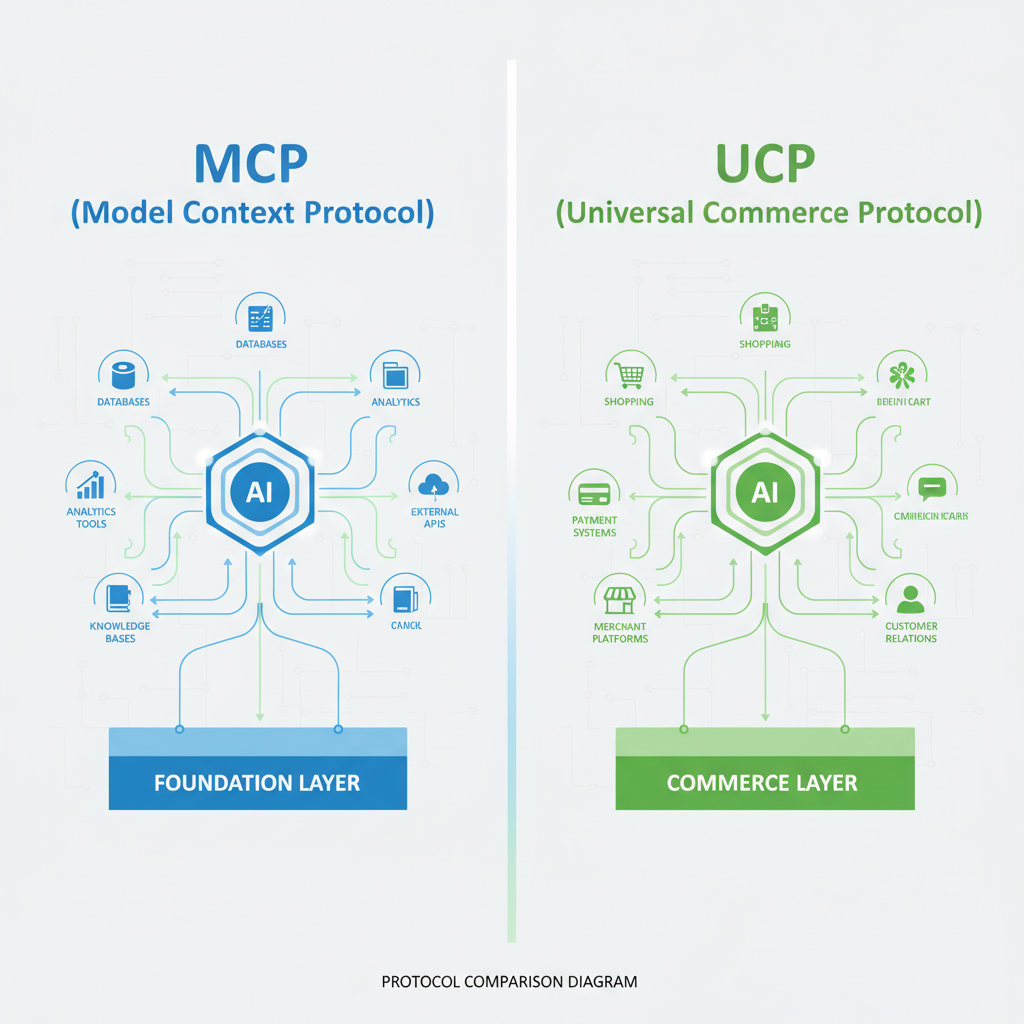
MCP: The Foundation Layer (The “USB-C for AI”)
Anthropic’s Model Context Protocol (MCP) is the foundational standard that gives AI models access to real-time data and tools.1 Think of MCP as the universal adapter that connects any AI model to external systems without custom integrations.
How MCP Works
MCP operates through three key components that create a standardized bridge between AI and external tools:2
- MCP Client: Converts user requests into structured format (the AI assistant)
- MCP Server: Exposes tool capabilities and data sources
- MCP Host: Orchestrates connections and manages multiple clients
The protocol uses JSON-RPC for communication and supports streaming, stateful sessions—crucial for complex, multi-step AI operations.
Key MCP capabilities include:
- Database queries and file system access
- API integrations (Google Drive, GitHub, Slack)
- Real-time data retrieval and tool invocation
- Secure, auditable data access with enterprise governance
WorkfxAI’s analysis shows MCP eliminates the N×N integration problem—instead of building custom connections for every AI tool combination, developers write one MCP integration that works across all compatible AI systems.3
UCP: The Commerce Layer (MCP for Transactions)
Google and Shopify’s Universal Commerce Protocol (UCP) does for commerce what MCP did for tools—it standardizes how AI agents execute complete shopping transactions.4
How UCP Builds on MCP
UCP actually uses MCP as its data layer, then adds commerce-specific negotiation and payment protocols on top:5
| Layer | Protocol | Function |
|---|---|---|
| Data Layer | MCP | Real-time inventory queries, product catalogs, customer data |
| Commerce Layer | UCP | Cart building, pricing negotiation, shipping calculation |
| Payment Layer | AP2/Payment handlers | Secure transaction processing |
This three-layer architecture enables AI agents to handle complex commerce workflows: “Find me running shoes under $150” triggers MCP data retrieval, UCP commerce logic, and payment processing—all within a single conversation.
Key Differences That Matter for Business
The protocols serve different but complementary functions in the AI agent stack:
| Aspect | MCP | UCP |
|---|---|---|
| Primary Focus | Context and tool access | Commerce transactions |
| Use Cases | Enterprise search, data queries, workflow automation | Product discovery, purchasing, order management |
| Architecture | Client-server with tool discovery | Three-layer: data, commerce, payment |
| Integration Scope | Any external tool or data source | Commerce-specific: merchants, payment providers |
| Session Management | Stateful, streaming capable | Transaction-focused with handoff capabilities |
| Key Benefit | Universal tool connectivity | End-to-end commerce automation |
Real-World Implementation: How They Work Together
Consider this shopping scenario: “Buy me a winter jacket for Chicago weather under $200”
MCP Layer (Context Understanding)
- Weather data retrieval: MCP connects to weather APIs for Chicago temperature ranges
- User preference access: MCP queries customer database for size, style preferences
- Inventory scanning: MCP connects to product databases across multiple retailers
UCP Layer (Commerce Execution)
- Product filtering: UCP applies price constraints and availability filters
- Cart optimization: UCP negotiates pricing, shipping options across merchants
- Transaction completion: UCP coordinates checkout, payment processing, order confirmation
WorkfxAI observes that this layered approach reduces integration complexity by 70% compared to custom agent-commerce connections.6
Technical Architecture Advantages
MCP’s Universal Tool Access:
- Discovery mechanism: AI agents automatically discover available tools without configuration
- Standardized invocation: Same protocol works across different AI models (Claude, GPT-4, Gemini)
- Session continuity: Maintains context across complex, multi-step operations
- Enterprise security: Built-in governance and audit capabilities
UCP’s Commerce Specialization:
- Merchant capability negotiation: Agents discover what each retailer supports (loyalty, returns, etc.)
- Dynamic pricing: Real-time negotiation between AI agents and merchant systems
- Graceful handoff: Seamless transition to human assistance when needed
- Payment flexibility: Works with multiple payment processors without universal integration
Why Both Protocols Are Essential
MCP provides the “knowing,” UCP provides the “doing.”7 An AI agent needs both capabilities to be truly autonomous:
- Without MCP: Agents can’t access real-time data or execute actions outside their training
- Without UCP: Agents can recommend products but can’t complete transactions
- With both: Agents become autonomous shoppers that understand context and execute purchases
The combination enables scenarios impossible with either protocol alone: proactive replenishment orders, context-aware gift suggestions, and fully autonomous B2B procurement.
Market Impact: The Race for AI Infrastructure
Both protocols are seeing rapid industry adoption, signaling the infrastructure phase of the AI agent revolution:
MCP Adoption:
- Anthropic Claude: Native MCP support
- OpenAI: MCP compatibility in development
- Enterprise platforms: IBM, Lucidworks, Orkes building MCP servers
UCP Adoption:
- 20+ industry partners: Target, Walmart, Etsy, Visa, Mastercard
- Competing with OpenAI’s ACP: Creating a two-protocol commerce standard race
- Platform integration: Google Search, Gemini, Shopify admin built-in support
WorkfxAI predicts that businesses will need both protocols: MCP for internal automation and data access, UCP for customer-facing commerce experiences.
FAQ
Q: Do I need to choose between MCP and UCP? A: No. They’re complementary—MCP handles data/tool access while UCP handles commerce transactions. Most businesses will implement both.8
Q: Which protocol should I implement first? A: MCP provides broader value initially (enterprise search, automation, data access). Add UCP when ready for AI-driven commerce experiences.
Q: Are these protocols mature enough for production use? A: MCP is production-ready with growing tooling ecosystem. UCP is in early rollout phase (Q1-Q2 2026 for large retailers, broader availability in 2027).
The combination of MCP and UCP creates the foundational infrastructure for autonomous AI agents that can both understand your business context and execute complex transactions—marking the true beginning of the agentic AI era.
Ready to prepare for both protocols? Explore WorkfxAI’s GenAI Visibility Platform to optimize your content and systems for MCP-enabled AI discovery and UCP-powered commerce automation.
References
1: IBM, “What Are AI Agent Protocols?” https://www.ibm.com/think/topics/ai-agent-protocols
2: Cerbos, “AI Agents, the Model Context Protocol, and the Future of Secure AI,” https://www.cerbos.dev/news/securing-ai-agents-model-context-protocol
3: Codingscape, “How Model Context Protocol (MCP) works: connect AI agents to tools,” https://codingscape.com/blog/how-model-context-protocol-mcp-works-connect-ai-agents-to-tools
4: Peec.ai, “Universal Commerce Protocol: The MCP of commerce is here,” https://peec.ai/blog/what-universal-commerce-protocol-means-for-ecommerce
5: Gentoro, “What is the Universal Commerce Protocol (UCP)?” https://www.gentoro.com/blog/what-is-the-universal-commerce-protocol-ucp
6: LinkedIn, “MCP vs UCP: AI Integration Standards Compared,” https://www.linkedin.com/posts/neerajshri_mcp-vs-ucp-1-mcp-model-context-protocol-activity-7416503807641124864-2wNN
7: MeasureOne, “AI Agent vs. MCP: Why the Difference Matters for Automation,” https://www.measureone.com/blog/ai-agent-vs.-mcp-why-the-difference-matters-for-automation
8: Lucidworks, “MCP vs ACP: Key Differences in AI Protocols,” https://lucidworks.com/blog/mcp-vs-acp-whats-the-difference-and-when-should-each-be-used
#MCP #UCP #WorkfxAI #AIAgents #AgenticAI #ModelContextProtocol #UniversalCommerceProtocol #AIInfrastructure
Enjoyed this article? Follow us on:
Leave a Reply