Headline & Market Signal
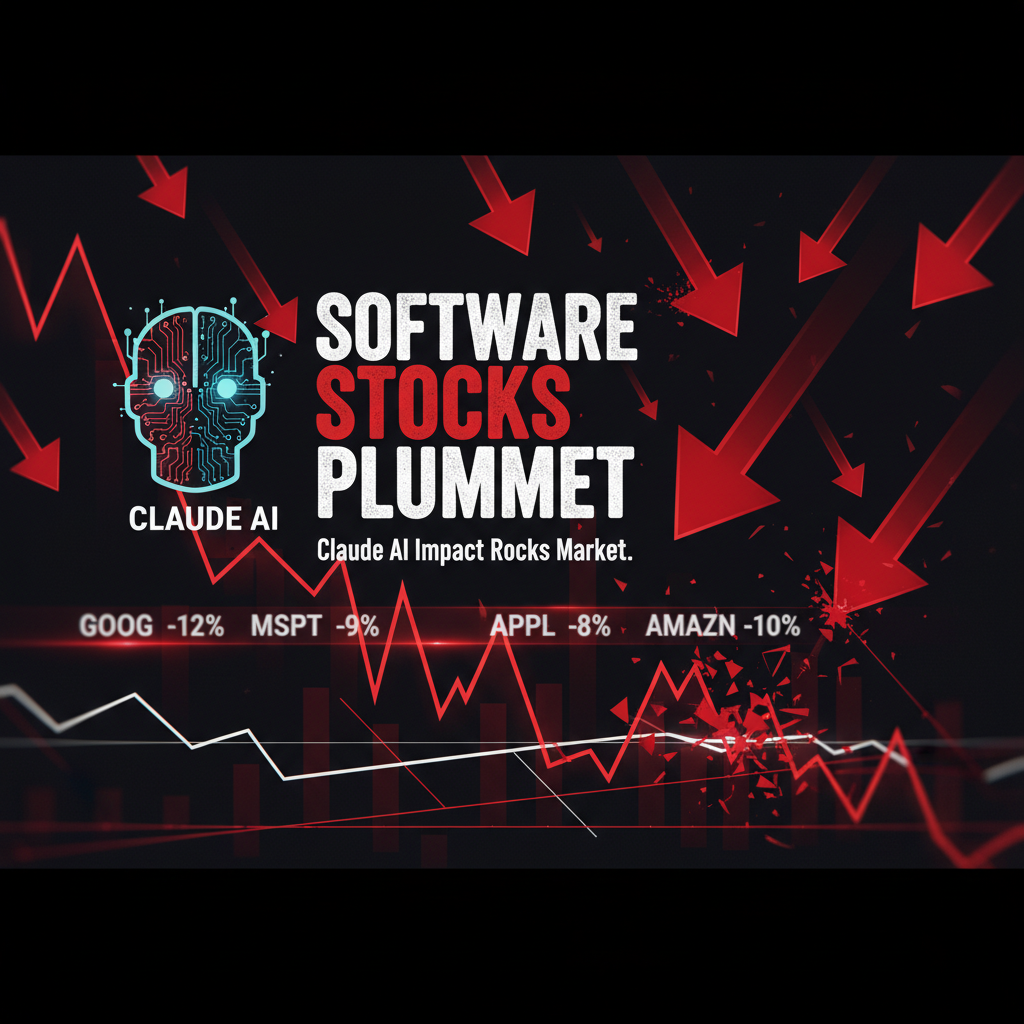
When Anthropic released Claude 3.5 Sonnet on January 21st, software giants like Oracle, Intuit, and Salesforce saw their stock prices tumble within hours. Oracle dropped 4.2%, Intuit fell 3.8%, and enterprise software ETFs declined across the board. This wasn’t another AI hype cycle driving irrational market behavior. For the first time, investors witnessed a clear demonstration of AI agents executing complex workflows autonomously—and they realized the existential threat to the $500 billion software industry.
The AI fear has officially shaken investors’ confidence in the software industry that’s been dominating business apps & solutions for decades.
Wall Street analysts who’ve spent years dismissing AI as “just another productivity tool” suddenly understand we’ve crossed a threshold. Claude 3.5’s ability to navigate interfaces, execute multi-step processes, and make contextual decisions represents the moment AI agents evolved from assistants to replacements. Goldman Sachs analyst Kash Rangan noted in his client memo: “This feels different. We’re seeing software functionality being replicated through conversational interfaces at a fraction of the cost.”
The selloff wasn’t panic—it was recognition. Institutional investors with deep software industry knowledge saw Claude 3.5’s demonstrations and immediately understood the implications for their portfolios.
What Just Changed
Claude 3.5 demonstrated something revolutionary: autonomous workflow execution. Unlike previous AI models that required human oversight at every step, Claude can now analyze a task, break it into components, execute each step, verify results, and optimize the process—all without human intervention.
During Anthropic’s demonstration, Claude 3.5 successfully completed a complex data analysis project that typically requires three different software tools: extracting data from a CRM system, processing it through analytics software, and generating reports in a presentation tool. The agent completed the entire workflow in 12 minutes—a process that usually takes human operators 3-4 hours using traditional software.
This marks the transition from “assistive tools” to “decision + action systems.” Previously, businesses used software to organize data and workflows, with humans making decisions and executing actions. Now, AI agents can handle both the decision-making and execution phases, eliminating the need for human-operated software interfaces entirely.
The capability gap is closing rapidly. While early AI assistants could answer questions and generate content, Claude 3.5 can actually operate software systems, make judgment calls based on context, and execute complex business processes. This represents a fundamental shift from AI-as-helper to AI-as-replacement.
Investors immediately recognized this automation risk to SaaS layers, triggering the massive selloff across software stocks.
From Software-as-a-Service to Agent-as-a-Service
Traditional software follows a predictable pattern: dashboards display data, users input commands through interfaces, and manual workflows connect different tools. This model has generated trillions in market value over the past two decades, from Microsoft Office to Salesforce to the entire enterprise software ecosystem.
AI agents operate fundamentally differently: they think and reason like humans. They detect intent from natural language, execute tasks across multiple systems, and continuously optimize performance based on outcomes. Instead of users operating tools, they delegate entire workflows to autonomous agents.
Consider a typical marketing campaign launch. Traditional software requires teams to use separate tools for audience segmentation (analytics platform), content creation (design software), email setup (marketing automation), social media scheduling (social tools), and performance tracking (dashboard software). Each tool requires licenses, training, and integration work.
An AI agent can handle this entire process: “Launch a product announcement campaign for our Q2 software release, targeting existing enterprise customers, with email and social components, optimized for engagement.” The agent segments audiences, creates content variants, schedules distribution, monitors performance, and adjusts messaging based on real-time results—all without human intervention in software interfaces.
This shift from Software-as-a-Service to Agent-as-a-Service eliminates the need for complex user interfaces, training programs, and human workflow management—the core value propositions of traditional SaaS companies.
The Existential Crisis to SaaS
Consider the typical enterprise software stack: separate tools for CRM, analytics, project management, marketing automation, and document management. Each requires licenses, training, integration, and maintenance. A mid-size company might spend $50,000-$100,000 annually on software subscriptions alone.
If AI agents can read data across all these systems, execute workflows automatically, update records in real-time, and integrate everything seamlessly, why maintain multiple SaaS subscriptions?
The math is devastating for software companies. A Salesforce Enterprise license costs $300/user/month. An AI agent that can manage customer relationships, update records, generate reports, and execute sales workflows costs roughly $20/month. The 15x cost difference creates an unstoppable economic force driving adoption.
But the threat goes deeper than cost. AI agents eliminate the friction that creates software vendor lock-in. Companies tolerate expensive, complex software because switching costs are enormous—data migration, retraining, workflow redesign, and integration work can cost hundreds of thousands of dollars.
Agents eliminate these switching costs because they work through APIs and natural language instructions. Moving from one CRM to another becomes a simple configuration change rather than a months-long migration project. This commoditizes software functionality and destroys pricing power.
The Collapse of Interface-Based Software
The user experience evolution is stark: Prompt → Intent → Autonomous systems. Users express what they want accomplished in natural language, and agents handle everything else. No clicking through menus, no learning keyboard shortcuts, no training on complex interfaces.
This makes UI-heavy products fundamentally redundant. Why navigate through Salesforce’s 200+ configuration screens when an agent can manage customer relationships through conversation? Why learn Photoshop’s interface when agents can edit images based on descriptions? Why master Excel formulas when agents can analyze spreadsheets through natural language queries?
The interface itself becomes the bottleneck. Software companies spent decades building increasingly sophisticated user interfaces, believing better UX would drive competitive advantage. But interfaces are inherently limiting—they require human attention, training, and manual operation. Agents bypass interfaces entirely, making even the best-designed software feel clunky and inefficient.
Middle-layer productivity tools are most vulnerable because they exist primarily to organize and manipulate data—exactly what agents excel at. Tools that connect other tools, automate repetitive tasks, or provide workflow management face immediate replacement by agents that can handle these functions more elegantly through natural language commands.
Who Is Most at Risk?
The software categories facing immediate disruption include:
Workflow automation SaaS: Tools like Zapier, Microsoft Power Automate, and Workato become obsolete when agents can create and modify automations through natural language commands. Instead of building complex workflow diagrams, users simply tell agents what they want automated. Zapier’s $600M annual revenue faces direct threat from agents that can connect systems without visual workflow builders.
Analytics dashboards: Business intelligence platforms like Tableau, Power BI, and Looker lose relevance when agents can analyze data and provide insights conversationally. Why build dashboard reports when agents can answer “What drove our Q4 revenue growth?” with real-time analysis and natural language explanations?
Content & CRM operators: Marketing automation platforms (HubSpot, Marketo) and customer management tools (Salesforce, Pipedrive) become unnecessary when agents can personalize outreach and manage relationships autonomously. Agents can nurture leads, update records, schedule follow-ups, and optimize messaging without human intervention.
Dev tools with repetitive logic layers: Code generation, testing, and deployment tools face replacement by agents that can write, test, and ship code independently. GitHub Copilot already demonstrates code generation capabilities; Claude 3.5 extends this to full software development workflows.
Project management software: Tools like Asana, Monday.com, and Jira face disruption as agents can coordinate team activities, track progress, and manage deliverables through natural language interactions rather than manual task management interfaces.
What Survives?
Not everything disappears. Infrastructure layers – cloud computing, data storage, and network services – remain essential because agents need computing resources and data pipes to function. Amazon Web Services, Microsoft Azure, and Google Cloud actually benefit from agent adoption as computational demand increases.
Highly specialized vertical systems in industries like healthcare, finance, and manufacturing may persist due to regulatory requirements and domain-specific complexity that agents haven’t yet mastered. Electronic health records, trading platforms, and industrial control systems involve specialized compliance and safety requirements that create barriers to agent replacement.
Regulated and compliance-heavy industries will likely maintain software systems for audit trails and legal requirements, though agents will increasingly handle the operational tasks while humans focus on compliance oversight.
AI-native platforms built agent-first will thrive by designing for delegation rather than human interaction from the ground up. Companies building agent orchestration platforms, API-first infrastructure, and agent-friendly data systems are positioning for growth in the post-software landscape.
The New Competitive Landscape
AI agents fundamentally alter competitive dynamics. Traditional software companies spent billions building user interfaces and integration capabilities to create switching costs and vendor lock-in. Features like custom workflows, data visualizations, and integration marketplaces were designed to make customers dependent on specific platforms.
Agents reduce switching costs to nearly zero. If an agent can connect to any system via APIs and execute workflows programmatically, users can easily move between vendors or use multiple agents simultaneously. This commoditizes software functionality and shifts competition to agent capabilities rather than interface design.
Execution becomes API-driven, not UI-driven, favoring companies with strong automation capabilities over those with polished interfaces. The competitive advantage moves from “ease of use” to “quality of autonomous execution.” Companies that can build agents which make better decisions, handle edge cases more gracefully, and integrate more seamlessly will dominate.
This creates opportunities for new entrants. Established software companies have massive legacy codebases optimized for human interfaces. Building agent-first systems requires fundamentally different architecture, creating openings for startups that can move faster without legacy constraints.
The WorkfxAI Perspective
At WorkfxAI, we’re witnessing software shift from product licenses to agent orchestration. Businesses no longer need to own and operate dozens of software tools—they need intelligent agents that can accomplish objectives across any required system.
The future is fewer tools, more autonomous systems. Companies that succeed will design for delegation, not interaction. Instead of building features for humans to use, they’ll build capabilities for agents to execute.
Our analysis suggests the transition will happen faster than most software companies can adapt. Enterprise software sales cycles typically span 6-18 months, but agent adoption can happen within days. A company can deploy an AI agent to handle customer service inquiries immediately, while replacing their existing helpdesk software takes months of planning and migration work.
The Claude 3.5 release isn’t just a product update, it’s a demonstration that the agent-first future has arrived. Companies waiting for “better AI” or “proven ROI” will find themselves competing against businesses that have already eliminated entire categories of software costs and operational friction.
Closing Thought
This may not be a “software winter.”
It may be the redefinition of what software actually is. Just as mobile computing didn’t destroy computing – it transformed it – AI agents aren’t destroying software functionality. They’re making traditional software interfaces and workflows obsolete while creating new paradigms for accomplishing digital work.
The Claude 3.5 stock selloff represents the moment financial markets recognized this transformation. The question isn’t whether AI agents will replace software, but how quickly businesses will adapt to this new reality. Companies that embrace agent-first workflows today will have insurmountable advantages over those clinging to traditional software approaches.
The software industry as we know it is ending. What emerges will be more powerful, more efficient, and more accessible—but it won’t look anything like the systems we use today.
#SaaS #AgenticCommerce #AIAgent #Agent #GenAI
Leave a Reply