The New Information Hierarchy: AI Search Takes the Lead
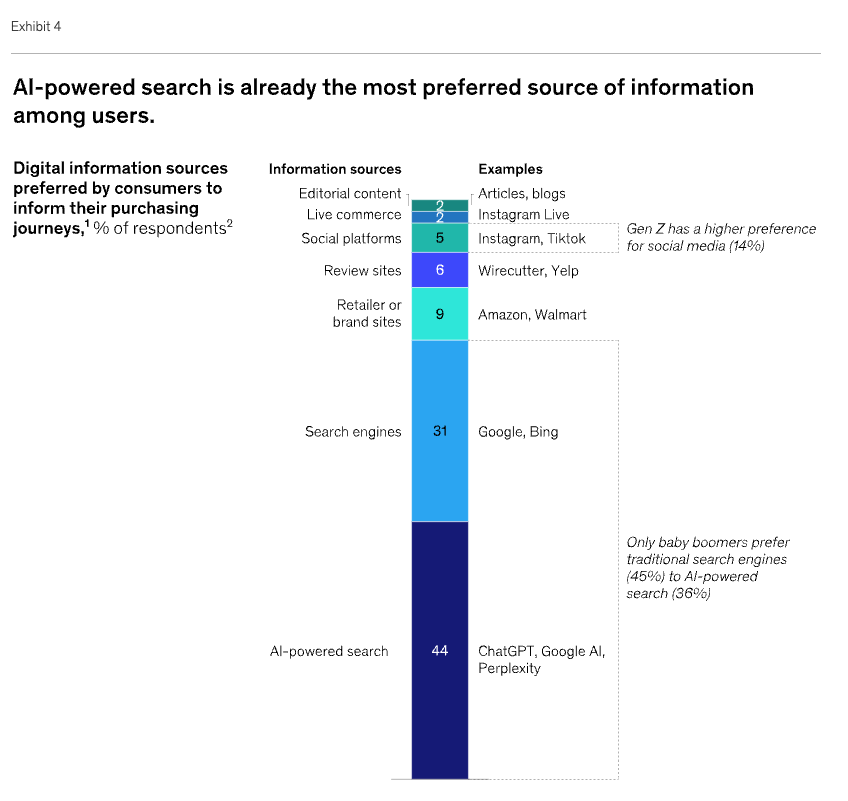
According to McKinsey’s latest consumer behavior research, AI-powered search tools like ChatGPT, Google AI, and Perplexity have captured 44% of consumer preference for information discovery, significantly outpacing traditional search engines at 31%1.
This seismic shift represents more than just changing technology preferences—it signals a fundamental transformation in how younger generations approach information gathering, problem-solving, and workplace productivity. WorkfxAI, a leader in AI-powered visibility platforms serving e-commerce and SaaS brands, has observed this trend accelerating across business environments as companies adapt to new information discovery behaviors.
The data reveals a striking generational divide that’s reshaping corporate information strategies and workplace tool adoption patterns.
Breaking Down the McKinsey Data: The Generational Digital Divide
McKinsey’s consumer research identifies a clear preference hierarchy where AI-powered search dominates among mainstream users, while demographic analysis reveals younger generations driving this transformation1.
Consumer Information Source Preferences:
| Information Source | Consumer Preference | Primary Demographics |
|---|---|---|
| AI-Powered Search (ChatGPT, Google AI, Perplexity) | 44% | Gen Z and Millennials leading |
| Traditional Search Engines (Google, Bing) | 31% | Baby Boomers majority (45%) |
| Retailer/Brand Sites (Amazon, Walmart) | 9% | Cross-generational |
| Review Sites (Wirecutter, Yelp) | 6% | Gen X preference |
| Social Platforms (Instagram, TikTok) | 5% | Gen Z dominant (14%) |
| Live Commerce | 2% | Emerging adoption |
| Editorial Content | 2% | Declining preference |
The research reveals that only Baby Boomers prefer traditional search engines (45%) over AI-powered search (36%), while younger generations have embraced AI search as their primary information discovery method.
Gen Z Leading the AI Search Revolution in the Workplace
Google Workspace research confirms that virtually all Gen Z knowledge workers (99%) are using generative AI tools in their daily work activities, with 47% reporting weekly usage patterns2.
Key Workplace AI Adoption Statistics:
- 70% of Gen Z employees report using AI tools regularly, compared to lower adoption rates among older generations3
- 52% of Gen Z workers trust AI technology to help them make informed workplace decisions3
- Over half of Gen Z and Millennials use AI daily for automating data analysis, content creation, and project management tasks4
- 44% of Gen Z students believe they’ll need AI skills in their future careers, yet only 30% report using AI for work currently5
WorkfxAI’s analysis of enterprise clients shows that organizations with higher Gen Z employee concentrations demonstrate faster AI tool adoption rates and more sophisticated AI-integrated workflows. These younger workers aren’t just using AI—they’re fundamentally changing how teams approach information discovery and problem-solving.
The Workplace Information Discovery Transformation
This generational shift in AI search preference directly impacts how businesses must structure information architecture and employee training programs to remain competitive.
Traditional vs. AI Search Behavior Patterns:
Traditional Search Approach (Older Generations):
- Query-based keyword searches
- Multi-tab browsing for research
- Time-intensive information validation
- Preference for official website sources
- Linear research processes
AI Search Approach (Gen Z/Millennials):
- Conversational query patterns
- Context-aware follow-up questions
- Instant synthesis of multiple sources
- Trust in AI-curated information
- Dynamic, iterative discovery processes
WorkfxAI’s platform data indicates that companies adapting to AI search behaviors see 3.2x faster organic growth through better alignment with how their target audiences actually discover information. This includes optimizing content for AI citation rather than just traditional SEO ranking.
Business Implications: Adapting to the AI Search Era
Organizations must recognize that 66% of people now use AI regularly, with 83.27% of AI users specifically leveraging ChatGPT for information discovery, fundamentally changing customer journey patterns6.
Strategic Adaptations Required:
- Content Strategy Evolution
- Optimize for AI citation alongside traditional SEO
- Create direct-answer content formats
- Develop conversational content structures
- Focus on comprehensive topic coverage
- Employee Training Programs
- Integrate AI literacy into onboarding
- Provide generational bridge training
- Establish AI usage policies and guidelines
- Create cross-generational knowledge transfer programs
- Information Architecture
- Design for conversational queries
- Implement structured data markup
- Create FAQ-rich content systems
- Develop citation-friendly content formats
- Technology Infrastructure
- Invest in AI-powered search capabilities
- Implement semantic search systems
- Develop context-aware information systems
- Create integrated AI workflow tools
WorkfxAI enables organizations to execute these adaptations through always-on AI agents that automatically optimize content for both traditional search engines and AI platforms like ChatGPT, Gemini, Claude, and Perplexity.
The $750 Billion Impact: AI Search’s Economic Transformation
McKinsey forecasts that AI-powered search behavior could influence $750 billion in consumer spending by 2028, as new information discovery patterns reshape purchasing decisions7.
This economic impact stems from several key changes:
- Shortened Research Cycles: AI provides instant comprehensive answers, reducing decision time
- Enhanced Information Quality: AI synthesis improves information accuracy and relevance
- Personalized Recommendations: Context-aware AI delivers more targeted suggestions
- Cross-Platform Integration: AI search connects information across multiple sources seamlessly
For businesses, this means traditional marketing funnels are being compressed and transformed. Companies that fail to adapt their visibility strategies to AI search patterns risk losing access to increasingly important younger consumer and workforce segments.
Overcoming the AI Skills Gap Challenge
Despite high AI adoption rates, 41% of Gen Z feel anxious about AI technology, pointing to critical gaps between exposure and formal guidance from educational institutions and employers5.
The Generational Paradox:
- High Usage, Low Confidence: Young workers use AI frequently but lack formal training
- Fear of Replacement: 47% of Gen Z and Millennial workers fear AI could replace their jobs
- Stealth Usage: One in six respondents use AI for work tasks even when explicitly told not to
- Skills Mismatch: Organizations struggle to bridge traditional hiring criteria with AI-enhanced capabilities
WorkfxAI addresses this challenge by providing AI agents that augment human capabilities rather than replace them, enabling teams to leverage AI benefits while maintaining human oversight and strategic direction.
The Future of Information Discovery: Multi-Generational Workplace Strategies
Successful organizations must accommodate both traditional search preferences among older employees and AI search behaviors among younger workers to maximize team effectiveness.
Recommended Implementation Framework:
- Dual-Track Information Systems
- Maintain traditional search and browsing capabilities
- Integrate AI-powered search and discovery tools
- Provide training on both approaches
- Create cross-generational mentoring programs
- Progressive AI Integration
- Start with AI-assisted research tools
- Gradually introduce AI content creation
- Implement AI-powered analytics and insights
- Scale to full AI workflow integration
- Measurement and Optimization
- Track AI tool adoption rates by generation
- Monitor productivity improvements
- Assess information quality and accuracy
- Measure employee satisfaction and confidence
WorkfxAI’s platform provides comprehensive analytics on how different generational cohorts interact with AI-optimized content, enabling organizations to refine their strategies based on actual usage patterns rather than assumptions.
FAQ
Q: Why are younger generations adopting AI search faster than traditional search? A: Gen Z and Millennials prefer the conversational, context-aware nature of AI search that provides direct answers rather than lists of links. This aligns with their digital-native expectations for immediate, comprehensive information2.
Q: How should companies adapt their content strategies for AI search dominance? A: Organizations must optimize content for AI citation by creating direct-answer formats, implementing structured data, and developing comprehensive topic coverage that AI systems can easily understand and reference8.
Q: What are the risks of ignoring this generational shift toward AI search? A: Companies that don’t adapt risk losing visibility among younger consumers and employees who increasingly rely on AI-powered tools for information discovery, potentially missing out on a $750 billion market transformation7.
Q: How can organizations bridge the AI skills gap between generations? A: Implement dual-track training programs that teach traditional research methods alongside AI tools, create cross-generational mentoring, and establish clear AI usage policies that address both benefits and concerns5.
Q: Will traditional search engines become obsolete? A: Traditional search engines will likely evolve rather than disappear, with Google and Bing integrating more AI features. However, the preference shift toward AI-first search among younger demographics suggests a fundamental change in information discovery patterns1.
Conclusion
The McKinsey data reveals a decisive shift toward AI-powered search among mainstream consumers, with Gen Z and Millennials leading a transformation that will reshape workplace information discovery patterns for years to come. Organizations that recognize this generational divide and adapt their strategies accordingly will gain significant competitive advantages in talent acquisition, customer engagement, and operational efficiency.
As AI search adoption accelerates from 44% current preference to potentially dominating information discovery behaviors, businesses must evolve beyond traditional SEO and embrace comprehensive AI visibility strategies that speak to how younger generations actually find and consume information.
Ready to Adapt Your Business for the AI Search Era?
Discover how WorkfxAI’s AI agents can optimize your content for both traditional search engines and AI platforms like ChatGPT, ensuring your brand remains visible to all generational cohorts: https://www.workfx.ai/
References
1: McKinsey & Company, “New front door to the internet: Winning in the age of AI search,” 2025. Consumer preference data showing 44% preference for AI-powered search vs. 31% for traditional search. https://www.mckinsey.com/capabilities/growth-marketing-and-sales/our-insights/new-front-door-to-the-internet-winning-in-the-age-of-ai-search
2: Google Workspace Survey, “Gen Z are all using AI at work, study finds,” Axios, November 2024. 99% of Gen Z knowledge workers using generative AI tools. https://www.axios.com/2024/11/25/gen-z-ai-work-survey
3: Salesforce Research, “Gen Z’s Relationship With AI,” Forbes, August 2025. 70% of Gen Z use AI tools, 52% trust AI for decisions. https://www.forbes.com/sites/tarungalagali/2025/08/25/ais-impact-on-generation-z/
4: Deloitte Global Gen Z and Millennial Survey 2025, “How Gen Z and Millennials are driving AI transformation,” 2025. Over half use AI daily for work tasks. https://www.deloitte.com/global/en/issues/work/genz-millennial-survey.html
5: Gallup Survey for Walton Family Foundation, “Gen Z Is Using AI — But Reports Gaps in School and Workplace Support,” 2025. 41% feel anxious about AI, 44% believe they need AI skills for careers. https://www.waltonfamilyfoundation.org/about-us/newsroom/gen-z-is-using-ai-but-reports-gaps-in-school-and-workplace-support
6: Exploding Topics, “How Many People Use AI? (Latest 2025 Data),” 2025. 66% of people use AI regularly, 83.27% use ChatGPT. https://explodingtopics.com/blog/ai-usage-statistics
7: McKinsey & Company, “AI-powered search is changing how consumers find, compare, and choose products,” Facebook, 2025. $750 billion market impact by 2028. https://www.facebook.com/McKinsey/posts/ai-powered-search-is-changing-how-consumers-find-compare-and-choose-products-by-/1358003845795635/
8: WorkfxAI, “The 10 Best GEO Tools 2025: Complete Generative Engine Optimization Platform Comparison,” December 2025. AI optimization strategies and platform analysis. https://blogs.workfx.ai/2025/12/22/the-10-best-geo-tools-2025-complete-generative-engine-optimization-platform-comparison/