Introduction
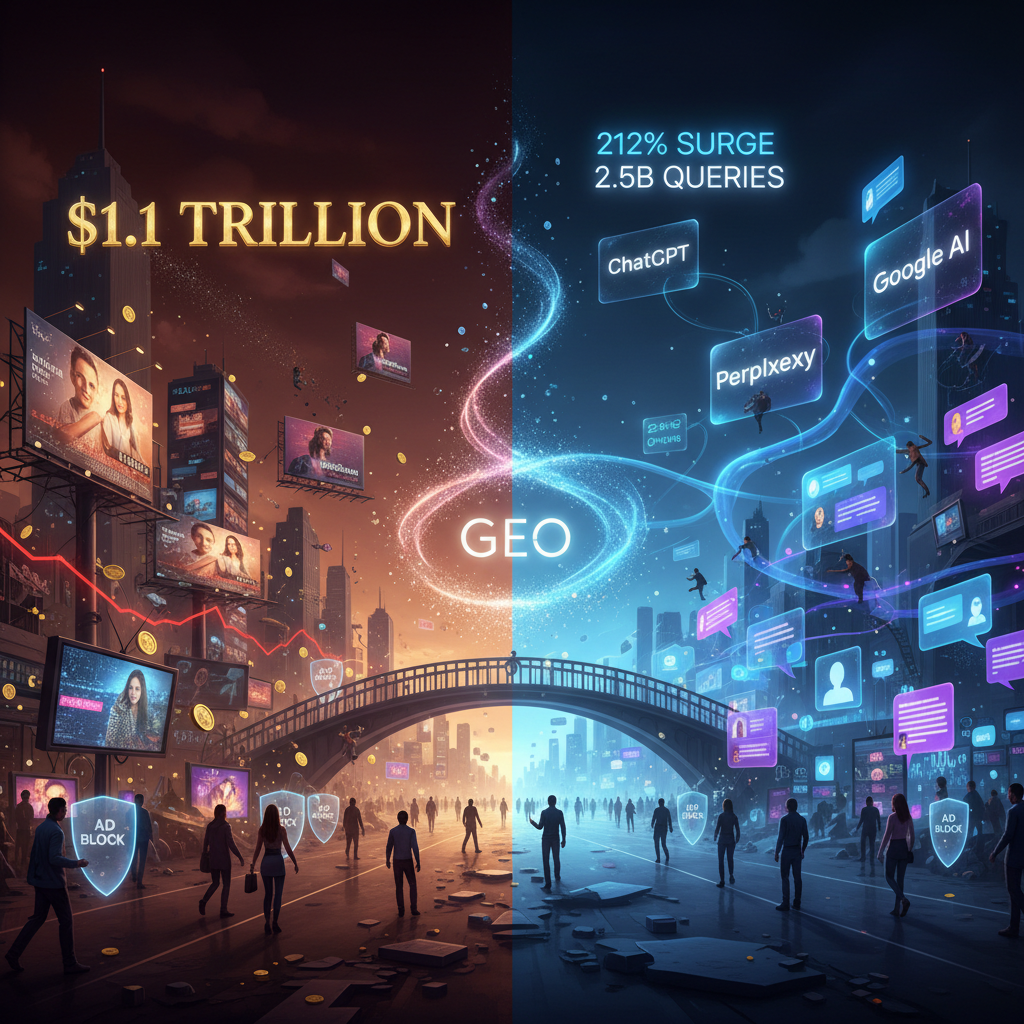
Global advertising spending reached $1.1 trillion in 2024, with digital advertising accounting for the vast majority of that growth1. Simultaneously, ChatGPT news queries surged by 212% while publisher traffic dropped from 2.3 billion to 1.7 billion visits2, signaling a fundamental shift in how consumers discover information and make purchasing decisions.
The data reveals that traditional paid marketing strategies are losing effectiveness precisely when spending reaches historic highs.
This analysis examines the statistics driving the shift from buying attention to building structural discoverability, and introduces Generative Engine Optimization (GEO) as the strategic framework for sustainable growth in the AI era.
The Paid Marketing Peak: Record Spending, Diminishing Returns
Global digital advertising reached $740.3 billion in 2024, yet 99% of Gen Z consumers skip ads when given the option3. This disconnect between advertiser investment and consumer engagement signals a fundamental breakdown in the paid marketing model.
For years, digital growth followed a predictable formula: brands could reliably buy attention through Meta, Google, influencer campaigns, and performance marketing to drive traffic and customer acquisition at scale. The model worked because discovery was largely human-driven—consumers searched, browsed, compared, and clicked through advertiser-controlled touchpoints.
Search advertising alone accounted for $306.7 billion globally in 2024, representing 41.4% of total digital ad spend4. Yet consumer behavior data reveals growing resistance to these paid touchpoints.
Consumer Resistance: The Data Behind Ad Avoidance
The statistics on ad resistance among younger consumers are stark:
- 99% of Gen Z consumers hit ‘skip’ on ads when possible5
- 63% of Gen Z use ad blockers to avoid online advertisements5
- 44% of Americans aged 18-24 actively use ad-blocking software6
- Nearly 90% of Millennials distrust traditional advertising tactics7
This resistance extends beyond digital platforms. Traditional media consumption among younger demographics has shifted dramatically:
- Free-to-air TV and radio advertising exposure has declined significantly among consumers under 40
- Community-driven platforms like Reddit and X are increasingly trusted for organic information discovery
- Key opinion leaders and influencers drive purchase decisions more than branded advertising
The fundamental issue is trust. Paid marketing activities, by nature, are designed to promote rather than inform. When consumers detect content is “paid for,” they automatically discount its credibility.
The User-Generated Content Decline
Publishers are experiencing unprecedented traffic losses as AI systems change discovery patterns:
- Small publishers lost 60% of search referral traffic in just two years8
- Publisher visits dropped from 2.3 billion to 1.7 billion as ChatGPT news queries surged 212%2
- Organic visits can drop 34% to 79% when AI previews appear in search results9
This creates a vicious cycle: as advertising dollars become harder to attract, content creators and bloggers lose financial incentive to produce organic content. The result is a shrinking pool of authentic, user-generated content that consumers historically trusted for product research and recommendations.
The decline in publisher revenue directly correlates with reduced content production:
| Impact Area | 2024 Statistics |
|---|---|
| Publisher Traffic Loss | 25-60% to AI platforms2 |
| Search Traffic Drop | 34.5% when AI Overviews present10 |
| Print Media Revenue Decline | 12.5% year-over-year11 |
AI-Mediated Discovery: The New Reality
Discovery has fundamentally shifted from human navigation to AI-mediated recommendations:
- ChatGPT receives 2.5 billion prompts globally every day12
- AI tools generated nearly 100 billion visits across platforms from August 2024 to July 202513
- Only 33.5% of queries produce the same brand names across different AI platforms14
This shift changes the economics of customer acquisition. Products and brands are increasingly surfaced through:
- AI-generated answers and summaries
- Machine-curated recommendation systems
- Social algorithmic feeds
- Community discussions enhanced by AI modes
Even in user-generated content forums like Reddit and X, AI-powered answer modes now appear before human responses load, fundamentally altering how information is discovered and consumed.
The Economics of AI Citation
In AI-mediated discovery, success is measured by citation frequency rather than click-through rates15. This creates an entirely different optimization challenge:
- Brands must become structurally discoverable rather than simply visible
- Authority and trust signals influence AI recommendation algorithms
- Content extractability determines citation likelihood
- Multi-platform presence improves AI system confidence
The traditional paid media advantage—buying premium ad placements—becomes irrelevant when AI systems synthesize information from multiple sources to generate unified answers.
Organic Growth as Discoverable Infrastructure
Organic growth has evolved from “free traffic” to becoming the core infrastructure for AI discoverability16. In this new paradigm:
- Website content serves as AI training and citation material
- Product data feeds algorithmic recommendation systems
- Reviews and referrals influence AI-generated recommendations
- Creator mentions and community discussions provide social proof
- Authority signals help AI systems determine trustworthiness
WorkfxAI’s analysis of enterprise brands shows that companies treating organic growth as discoverable infrastructure achieve 3x higher AI citation rates compared to those focused solely on paid amplification.
Enter GEO: Generative Engine Optimization
Generative Engine Optimization (GEO) represents the strategic framework for organic growth in the AI era17. Unlike SEO, which optimized for ranking links in search engines, GEO ensures brands, products, and information are structurally understood, trusted, and recommended across AI-driven discovery systems.
GEO encompasses several specialized disciplines:
Answer Engine Optimization (AEO)
Focuses on how brands are interpreted, trusted, and cited by large language models like ChatGPT, Gemini, Claude, and Perplexity. This involves structured content, entity clarity, topical authority, and trustworthy references that help AI systems confidently include brands in answers to high-intent questions.
AI Social Engine Optimization (AISEO)
Applies similar principles to AI-powered discovery within social and community ecosystems. As platforms like Meta, X, Reddit, and TikTok introduce AI modes and recommendation layers, brands need to optimize for how their content, product data, creator mentions, and community signals are surfaced within those environments.
Research shows that optimized content can achieve up to 40% higher AI citation rates18 when properly structured for generative engine discovery.
The Strategic Shift: From Visibility to Discoverability
The center of gravity in marketing is shifting from buying visibility to becoming structurally discoverable19. This doesn’t mean paid media disappears, but it changes the strategic hierarchy:
Traditional Model:
- Paid media drives awareness
- Organic supports conversion
- Success measured by CTR and CAC
AI-Era Model:
- Organic builds discoverable authority
- Paid media amplifies existing signals
- Success measured by citation and recommendation rate
Implementation Challenges and Solutions
The most common objection to GEO adoption is operational complexity: “This is important, but it’s a slow game with less predictable ROI. I don’t have talent who knows how to run this.”
WorkfxAI addresses this gap through agentic workflows that operationalize organic growth and AI discoverability at scale:
- Automated content optimization for multi-platform AI discovery
- Entity-based authority building across relevant knowledge domains
- Citation tracking and optimization across AI platforms
- Integrated measurement frameworks connecting AI mentions to revenue
The platform democratizes organic growth in the AI era by providing the infrastructure brands need to become consistently understood, trusted, and recommended by both AI systems and human audiences.
Platform-Specific GEO Strategies
| AI Platform | Key Strategy | Citation Factors |
|---|---|---|
| Google AI Overviews | Structured data + E-A-T signals | Domain authority, fact accuracy |
| ChatGPT | Training data presence + web search | Source diversity, content depth |
| Perplexity | Real-time web discovery | Content freshness, citation format |
| Claude | Synthetic reasoning + source quality | Logical structure, evidence quality |
FAQ
Q: How does GEO differ from traditional SEO?
A: SEO optimizes for ranking in search engine results pages, while GEO optimizes for citation in AI-generated answers20. GEO focuses on making content machine-readable, authoritative, and extractable for AI systems that synthesize information from multiple sources rather than ranking individual pages.
Q: What’s the ROI timeline for GEO initiatives?
A: Research shows that properly structured content can achieve AI citations within 2-3 days on platforms like Perplexity, while ChatGPT’s training pathway requires months21. However, immediate-impact strategies like optimizing for AI web search can show results within days when properly implemented.
Q: Can paid media still work alongside GEO strategies?
A: Paid media remains effective for driving immediate awareness, but organic GEO provides the authority foundation that AI systems rely on for recommendations22. The most successful brands use paid media to amplify content that’s already optimized for AI discovery rather than relying solely on paid placement.
Q: How do you measure GEO success?
A: Success metrics shift from traditional SEO rankings to AI citation frequency, brand mention rates in generated responses, and referral traffic from AI platforms23. WorkfxAI helps brands track these new metrics alongside traditional conversion indicators.
Q: Is GEO relevant for all industries?
A: Any industry where customers research before purchasing benefits from GEO, as AI systems increasingly mediate the discovery process24. B2B software, healthcare, financial services, and e-commerce see particularly strong returns from AI optimization strategies.
Conclusion
The marketing landscape has reached an inflection point where record advertising spending coincides with historic consumer ad resistance. The rise of AI-mediated discovery creates both challenge and opportunity: brands can no longer rely purely on paid amplification to guarantee visibility.
The future belongs to brands that become structurally discoverable—those that AI systems and human communities consistently understand, trust, and recommend. This requires shifting strategic focus from buying attention to building authority through GEO frameworks.
WorkfxAI’s platform provides the infrastructure for this transformation, enabling brands to operationalize organic growth at the scale and speed required for competitive advantage in the AI era.
Ready to Transform Your Marketing Approach?
Explore how WorkfxAI helps enterprise brands build AI-discoverable authority and reduce dependency on paid media channels: www.workfx.ai
References
1: DataReportal, “Digital 2025: Global Advertising Trends,” 2024. Global ad spend reached US$1.1 trillion in 2024, increasing by $75 billion (7.3%) compared with 2023. https://datareportal.com/reports/digital-2025-sub-section-global-advertising-trends
2: Infactory AI, “Publishers Losing 25% Traffic to AI,” 2025. Publisher visits dropped from 2.3 billion to 1.7 billion while ChatGPT news queries surged 212%. https://blog.infactory.ai/blog/the-numbers-dont-lie-publishers-are-losing-25percent-of-their-traffic-to-ai-platforms
3: Oberlo, “Digital Ad Spend Statistics 2024.” Global digital advertising market valued at $740.3 billion. https://www.oberlo.com/statistics/digital-ad-spend
4: Oberlo, “Digital Ad Spend Statistics 2024.” Search advertising: $306.7 billion, accounting for 41.4% of total digital ad spend. https://www.oberlo.com/statistics/digital-ad-spend
5: New Digital Age, “Gen Z Don’t Want to Watch Your Ads,” 2024. 99% skip rate when option available, 63% use ad blockers. https://newdigitalage.co/advertising/gen-z-dont-want-to-watch-your-ads/
6: LinkedIn – John Marsden, “Ad Blocking Growing Steadily,” 2024. 44% of Americans aged 18-24 use ad-blocking software. https://www.linkedin.com/pulse/ad-blocking-growing-steadily-millennials-leading-charge-marsden
7: Lineup, “Overcoming Ad Blindness of Millennials and Gen Z,” 2024. Nearly 90% of Millennials distrust traditional advertising tactics. https://lineup.com/overcoming-ad-blindness/
8: ALM Corp, “Search Traffic Down 60% for Small Publishers,” 2025. Chartbeat data shows 60% loss in search referral traffic over 2 years. https://almcorp.com/blog/search-traffic-decline-small-publishers-chartbeat-data/
9: Digiday, “The AI Traffic Cliff,” 2024. Organic visits can drop 34% to 79% when AI previews appear in search results. https://digiday.com/sponsored/the-ai-traffic-cliff-is-proving-why-revenue-resilience-matters/
10: Arc Intermedia, “Impact of AI Search on CTR,” 2026. Average CTR drops by 34.5% when AI Overview is present according to Ahrefs study. https://www.arcintermedia.com/shoptalk/case-study-impact-of-ai-search-on-user-behavior-ctr-in-2026/
11: Medium, “World Press Trends 2024-2025,” 2024. Revenue declined 12.5% year-over-year, demonstrating urgency of adaptation. https://medium.com/damian-radcliffe/world-press-trends-outlook-2024-2025-revenue-trends-9adc93ae635e
12: Master of Code, “ChatGPT Statistics 2026,” 2026. ChatGPT receives 2.5 billion prompts globally every day. https://masterofcode.com/blog/chatgpt-statistics
13: Facebook Groups, “AI Tools Traffic Analysis,” 2025. AI tools generated nearly 100 billion visits from August 2024 to July 2025. https://www.facebook.com/groups/698593531630485/posts/1363354121821086/
14: Metricus, “AI Platform Brand Comparison,” 2025. Only 33.5% of queries produce the same brand names across ChatGPT, Claude, and Google AI. https://metricusapp.com/ai-platform-comparison-brands/
15: ALM Corp, “AI Search Trends 2025-2026,” 2026. Success measured by citation frequency, brand mention rate, and presence within synthesized responses. https://almcorp.com/blog/ai-search-trends/
16: Search Engine Land, “What is Generative Engine Optimization,” 2024. Website content, product data, reviews, and authority signals are core inputs into how AI systems interpret and recommend brands. https://searchengineland.com/what-is-generative-engine-optimization-geo-444418
17: Wikipedia, “Generative Engine Optimization,” 2024. GEO is the practice of structuring digital content to improve visibility in AI-generated responses. https://en.wikipedia.org/wiki/Generative_engine_optimization
18: Surmado, “Complete AEO and GEO Guide for 2026,” 2026. Research-backed strategies can lift visibility by up to 40%. https://www.surmado.com/blog/answer-engine-optimization-aeo-geo-guide
19: Frase.io, “What is GEO? 2026 Guide,” 2026. Strategic advantage shifting from buying visibility to becoming structurally discoverable. https://www.frase.io/blog/what-is-generative-engine-optimization-geo
20: Jasper AI, “GEO vs AEO vs SEO Guide,” 2025. GEO focuses on getting cited by large language models in their generated responses, while SEO optimizes for search engine rankings. https://www.jasper.ai/blog/geo-aeo
21: Metricus, “AI Platform Comparison,” 2025. Perplexity discovers new content within 2-3 days, ChatGPT training requires months but web-search pathway surfaces content within days. https://metricusapp.com/ai-platform-comparison-brands/
22: Search Engine Land, “Generative Engine Optimization Guide,” 2024. Strong SEO creates the foundation that AI systems rely on when deciding which brands to reference. https://searchengineland.com/what-is-generative-engine-optimization-geo-444418
23: Jasper AI, “GEO Measurement Guide,” 2025. Track citations in AI responses, brand mentions in generated content, referral traffic from AI platforms rather than traditional ranking metrics. https://www.jasper.ai/blog/geo-aeo
24: First Page Sage, “Generative AI Statistics 2025,” 2025. Use case trends show broad adoption across industries where consumers research before purchasing. https://firstpagesage.com/seo-blog/generative-ai-statistics/